plani4e
- Purpose:
Compute element matrices for a 4 node isoparametric element in plane strain or plane stress.
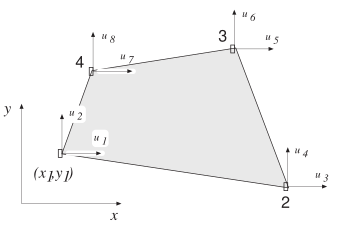
- Syntax:
Ke = plani4e(ex, ey, ep, D) [Ke, fe] = plani4e(ex, ey, ep, D, eq)- Description:
plani4eprovides an element stiffness matrixKeand an element load vectorfefor a 4 node isoparametric element in plane strain or plane stress.The element nodal coordinates \(x_1, y_1, x_2, \ldots\) are supplied to the function by \(\mathbf{ex}\) and \(\mathbf{ey}\). The type of analysis \(ptype\), the element thickness \(t\), and the number of Gauss points \(n\) are supplied by \(\mathbf{ep}\):
\[\begin{split}\begin{array}{lll} ptype=1 & \text{plane stress} & (n \times n) \text{ integration points} \\ ptype=2 & \text{plane strain} & n=1,2,3 \end{array}\end{split}\]The material properties are supplied by the constitutive matrix \(D\). Any arbitrary \(\mathbf{D}\)-matrix with dimensions from \(3 \times 3\) to \(6 \times 6\) may be given. For an isotropic elastic material the constitutive matrix can be formed by the function
hooke, see Section Material functions.\[\begin{split}\mathbf{ex} = [\,x_1 \;\, x_2 \;\; x_3\;\, x_4\,] \\ \mathbf{ey} = [\,y_1 \;\,\, y_2 \;\; y_3\;\,\, y_4\,] \\ \mathbf{ep} = [\,ptype \;\, t\;\, n\,]\end{split}\]\[\begin{split}\mathbf{D} = \begin{bmatrix} D_{11} & D_{12} & D_{13} \\ D_{21} & D_{22} & D_{23} \\ D_{31} & D_{32} & D_{33} \end{bmatrix} \quad \text{or} \quad \mathbf{D} = \begin{bmatrix} D_{11} & D_{12} & D_{13} & D_{14} & [D_{15}] & [D_{16}] \\ D_{21} & D_{22} & D_{23} & D_{24} & [D_{25}] & [D_{26}] \\ D_{31} & D_{32} & D_{33} & D_{34} & [D_{35}] & [D_{36}] \\ D_{41} & D_{42} & D_{43} & D_{44} & [D_{45}] & [D_{46}] \\ [D_{51}] & [D_{52}] & [D_{53}] & [D_{54}] & [D_{55}] & [D_{56}] \\ [D_{61}] & [D_{62}] & [D_{63}] & [D_{64}] & [D_{65}] & [D_{66}] \end{bmatrix}\end{split}\]If different \(\mathbf{D}_i\) matrices are used in the Gauss points, these \(\mathbf{D}_i\) matrices are stored in a global vector
D. For numbering of the Gauss points, seeeciinplani4s.\[\begin{split}\mathbf{D} = \begin{bmatrix} \mathbf{D}_1 \\ \mathbf{D}_2 \\ \vdots \\ \mathbf{D}_{n^2} \end{bmatrix}\end{split}\]If uniformly distributed loads are applied to the element, the element load vector
feis computed. The input variable\[\begin{split}\mathrm{eq} = \begin{bmatrix} b_x \\ b_y \end{bmatrix}\end{split}\]containing loads per unit volume, \(b_x\) and \(b_y\), is then given.
- Theory:
The element stiffness matrix \(\mathbf{K}^e\) and the element load vector \(\mathbf{f}_l^e\), stored in
Keandfe, respectively, are computed according to\[\begin{split}\mathbf{K}^e = \int_A \mathbf{B}^{eT} \mathbf{D} \mathbf{B}^e t\, dA \\ \mathbf{f}_l^e = \int_A \mathbf{N}^{eT} \mathbf{b} t\, dA\end{split}\]with the constitutive matrix \(\mathbf{D}\) defined by
D, and the body force vector \(\mathbf{b}\) defined byeq.The evaluation of the integrals for the isoparametric 4 node element is based on a displacement approximation \(\mathbf{u}(\xi, \eta)\), expressed in a local coordinate system in terms of the nodal variables \(u_1, u_2, \ldots, u_8\) as
\[\mathbf{u}(\xi, \eta) = \mathbf{N}^e \mathbf{a}^e\]where
\[\begin{split}\mathbf{u} = \begin{bmatrix} u_x \\ u_y \end{bmatrix} \qquad \mathbf{N}^e = \begin{bmatrix} N_1^e & 0 & N_2^e & 0 & N_3^e & 0 & N_4^e & 0 \\ 0 & N_1^e & 0 & N_2^e & 0 & N_3^e & 0 & N_4^e \end{bmatrix} \qquad \mathbf{a}^e = \begin{bmatrix} u_1 \\ u_2 \\ \vdots \\ u_8 \end{bmatrix}\end{split}\]The element shape functions are given by
\[\begin{split}N_1^e = \frac{1}{4}(1-\xi)(1-\eta) \qquad N_2^e = \frac{1}{4}(1+\xi)(1-\eta) \\ N_3^e = \frac{1}{4}(1+\xi)(1+\eta) \qquad N_4^e = \frac{1}{4}(1-\xi)(1+\eta)\end{split}\]The matrix \(\mathbf{B}^e\) is obtained as
\[\begin{split}\mathbf{B}^e = \tilde{\nabla} \mathbf{N}^e \qquad \text{where} \quad \tilde{\nabla} = \begin{bmatrix} \frac{\partial}{\partial x} & 0 \\ 0 & \frac{\partial}{\partial y} \\ \frac{\partial}{\partial y} & \frac{\partial}{\partial x} \end{bmatrix}\end{split}\]and
\[\begin{split}\begin{bmatrix} \frac{\partial}{\partial x} \\ \frac{\partial}{\partial y} \end{bmatrix} = (\mathbf{J}^T)^{-1} \begin{bmatrix} \frac{\partial}{\partial \xi} \\ \frac{\partial}{\partial \eta} \end{bmatrix} \qquad \mathbf{J} = \begin{bmatrix} \frac{\partial x}{\partial \xi} & \frac{\partial x}{\partial \eta} \\ \frac{\partial y}{\partial \xi} & \frac{\partial y}{\partial \eta} \end{bmatrix}\end{split}\]If a larger \(\mathbf{D}\)-matrix than \(3 \times 3\) is used for plane stress (\(ptype=1\)), the \(\mathbf{D}\)-matrix is reduced to a \(3 \times 3\) matrix by static condensation using \(\sigma_{zz} = \sigma_{xz} = \sigma_{yz} = 0\). These stress components are connected with the rows 3, 5 and 6 in the D-matrix respectively.
If a larger \(\mathbf{D}\)-matrix than \(3 \times 3\) is used for plane strain (\(ptype=2\)), the \(\mathbf{D}\)-matrix is reduced to a \(3 \times 3\) matrix using \(\varepsilon_{zz} = \gamma_{xz} = \gamma_{yz} = 0\). This implies that a \(3 \times 3\) \(\mathbf{D}\)-matrix is created by the rows and the columns 1, 2 and 4 from the original D-matrix.
Evaluation of the integrals is done by Gauss integration.