System functions
The group of system functions comprises functions for the setting up, solving, and elimination of systems of equations. The functions are separated in two groups:
Static system functions
Dynamic system functions
Static system functions concern the linear system of equations
where \(\mathbf{K}\) is the global stiffness matrix and \(\mathbf{f}\) is the global load
vector. Often used static system functions are assem and solveq.
The function assem assembles the global stiffness matrix and solveq
computes the global displacement vector \(\mathbf{a}\) considering the
boundary conditions. It should be noted that \(\mathbf{K}\), \(\mathbf{f}\), and \(\mathbf{a}\)
also represent analogous quantities in systems other than structural mechanical systems.
For example, in a heat flow problem \(\mathbf{K}\) represents the conductivity matrix,
\(\mathbf{f}\) the heat flow, and \(\mathbf{a}\) the temperature.
Dynamic system functions are related to different aspects of linear dynamic systems of coupled ordinary differential equations according to
for first-order systems and
for second-order systems. First-order systems occur typically in transient heat conduction and second-order systems occur in structural dynamics.
Static system functions
The group of static system functions comprises functions for setting up and solving the global system of equations. It also contains a function for eigenvalue analysis, a function for static condensation, a function for extraction of element displacements from the global displacement vector and a function for extraction of element coordinates.
assem
- Purpose:
Assemble element matrices.
- Syntax:
K = assem(edof, K, Ke)
[K, f] = assem(edof, K, Ke, f, fe)
- Description:
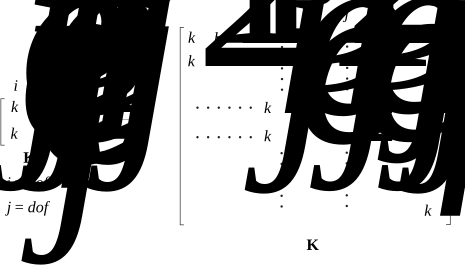
assem adds the element stiffness matrix
\(\mathbf{K}^e\), stored in Ke, to the structure stiffness matrix \(\mathbf{K}\), stored in K, according to the topology matrix edof.
The element topology matrix edof is defined as
edof\(= [el \quad \underbrace{dof_1\quad dof_2\quad\ldots \quad dof_{ned}}_{\text{global dof.}} ]\)
where the first column contains the element number, and columns 2 to \((ned+1)\) contain the corresponding global degrees of freedom (\(ned\) = number of element degrees of freedom).
In the case where the matrix \(\mathbf{K}^e\) is identical for several elements, assembling of these can be carried out simultaneously. Each row in edof then represents one element, i.e. \(nel\) is the total number of considered elements.
Edof\(= \left. \left[
\begin{array}{c}
el_1 \\
el_2 \\
\vdots \\
el_{nel}
\end{array}
\quad
\begin{array}{cccccc}
dof_1 & dof_2 & \cdots & \cdots & \cdots & dof_{ned} \\
dof_1 & dof_2 & \cdots & \cdots & \cdots & dof_{ned} \\
\vdots & \vdots & & & & \vdots \\
dof_1 & dof_2 & \cdots & \cdots & \cdots & dof_{ned}
\end{array}
\right] \right\} \text{one row for each element}\)
If \(\mathbf{fe}\) and \(\mathbf{f}\) are given in the function, the element load vector \(\mathbf{f}^e\) is also added to the global load vector \(\mathbf{f}\).
coordxtr
- Purpose:
Extract element coordinates from a global coordinate matrix.
- Syntax:
[Ex, Ey, Ez] = coordxtr(Edof, Coord, Dof, nen)
- Description:
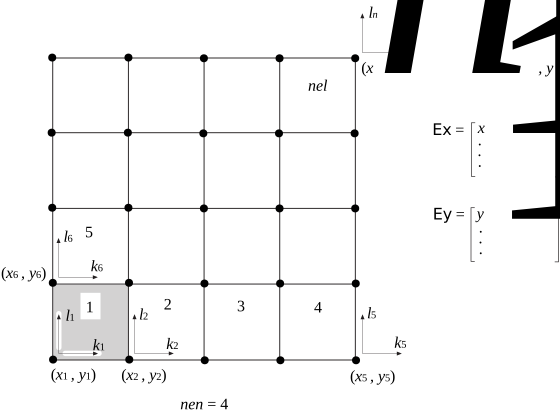
coordxtrextracts element nodal coordinates from the global coordinate matrixCoordfor elements with equal numbers of element nodes and dof’s.Input variables are the element topology matrix
Edof, defined inassem, the global coordinate matrixCoord, the global topology matrixDof, and the number of element nodes \(nen\) in each element.Coord\(= \begin{bmatrix} x_1 & y_1 & [z_1] \\ x_2 & y_2 & [z_2] \\ x_3 & y_3 & [z_3] \\ \vdots & \vdots & \vdots \\ x_n & y_n & [z_n] \end{bmatrix}\) \(\qquad\)Dof\(= \begin{bmatrix} k_1 & l_1 & \ldots & m_1 \\ k_2 & l_2 & \ldots & m_2 \\ k_3 & l_3 & \ldots & m_3 \\ \vdots & \vdots & \ldots & \vdots \\ k_n & l_n & \ldots & m_n \end{bmatrix}\) \(\qquad\)nen\(= [\;nen\;]\)The nodal coordinates defined in row \(i\) of
Coordcorrespond to the degrees of freedom of row \(i\) inDof. The components \(k_i\), \(l_i\) and \(m_i\) define the degrees of freedom of node \(i\), and \(n\) is the number of global nodes for the considered part of the FE-model.The output variables
Ex,Ey, andEzare matrices defined according toEx\(= \begin{bmatrix} x_1^1 & x_2^1 & x_3^1 & \ldots & x_{nen}^1 \\ x_1^2 & x_2^2 & x_3^2 & \ldots & x_{nen}^2 \\ \vdots & \vdots & \vdots & \vdots & \vdots \\ x_1^{nel} & x_2^{nel} & x_3^{nel} & \ldots & x_{nen}^{nel} \end{bmatrix}\)where row \(i\) gives the \(x\)-coordinates of the element defined in row \(i\) of
Edof, and where \(nel\) is the number of considered elements.The element coordinate data extracted by the function
coordxtrcan be used for plotting purposes and to create input data for the element stiffness functions.
eigen
- Purpose:
Solve the generalized eigenvalue problem.
- Syntax:
L = eigen(K, M)
L = eigen(K, M, b)
[L, X] = eigen(K, M)
[L, X] = eigen(K, M, b)
- Description:
eigensolves the eigenvalue problem\[| \mathbf{K} - \lambda \mathbf{M} | = 0\]where \(\mathbf{K}\) and \(\mathbf{M}\) are square matrices. The eigenvalues \(\lambda\) are stored in the vector \(\mathbf{L}\) and the corresponding eigenvectors in the matrix \(\mathbf{X}\).
If certain rows and columns in matrices \(\mathbf{K}\) and \(\mathbf{M}\) are to be eliminated in computing the eigenvalues,
bmust be given in the function. The rows (and columns) that are to be eliminated are described in the vectorbdefined asb\(=\begin{bmatrix} dof_1 \\ dof_2 \\ \vdots \\ dof_{nb} \end{bmatrix}\)The computed eigenvalues are given in order ranging from the smallest to the largest. The eigenvectors are normalized so that
\[\mathbf{X}^T \mathbf{M} \mathbf{X} = \mathbf{I}\]where \(\mathbf{I}\) is the identity matrix.
extract_ed
- Purpose:
Extract element nodal quantities from a global solution vector.
- Syntax:
ed = extract_ed(edof, a)
- Description:
The
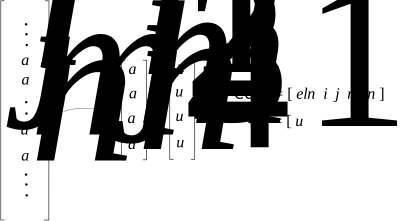
extract_edfunction extracts element displacements or corresponding quantities \(\mathbf{a}^e\) from the global solution vector \(\mathbf{a}\), stored ina.Input variables are the element topology matrix
edof, defined inassem, and the global solution vectora.The output variable
ed\(= (\mathbf{a}^e)^T\)contains the element displacement vector.
If
Edofcontains more than one element,Edwill be a matrixEd\(= \begin{bmatrix} (\mathbf{a}^e)_1^T \\ (\mathbf{a}^e)_2^T \\ \vdots \\ (\mathbf{a}^e)_{nel}^T \end{bmatrix}\)where row \(i\) gives the element displacements for the element defined in row \(i\) of
Edof, and \(nel\) is the total number of considered elements.- Example:
For the two-dimensional beam element, the
extract_edfunction will extract six nodal displacements for each element given inEdof, and create a matrixEdof size \((nel × 6)\).Ed\(= \begin{bmatrix} u_1 & u_2 & u_3 & u_4 & u_5 & u_6 \\ u_1 & u_2 & u_3 & u_4 & u_5 & u_6 \\ \vdots & \vdots & \vdots & \vdots & \vdots & \vdots \\ u_1 & u_2 & u_3 & u_4 & u_5 & u_6 \end{bmatrix}\)
red
- Purpose:
Reduce the size of a square matrix by omitting rows and columns.
- Syntax:
B = red(A, b)
[B, b] = red(A, b)
- Description:
B = red(A, b)reduces the square matrixAto a smaller matrixBby omitting rows and columns ofA. The indices for rows and columns to be omitted are specified by the column vectorb.- Example:
Assume that the matrix
Ais defined asA\(= \begin{bmatrix} 1 & 2 & 3 & 4 \\ 5 & 6 & 7 & 8 \\ 9 & 10 & 11 & 12 \\ 13 & 14 & 15 & 16 \end{bmatrix}\)and
basb\(= \begin{bmatrix} 2 \\ 4 \end{bmatrix}\)The statement
B = red(A, b)results in the matrixB\(= \begin{bmatrix} 1 & 3 \\ 9 & 11 \end{bmatrix}\)
solveq
- Purpose:
Solve equation system.
- Syntax:
a = solveq(K, f)
a = solveq(K, f, bcP, bc)
[a, r] = solveq(K, f, bc)
- Description:
The function
solveqsolves the equation system\[\mathbf{K}\;\mathbf{a} = \mathbf{f}\]where \(\mathbf{K}\) is a matrix and \(\mathbf{a}\) and \(\mathbf{f}\) are vectors.
The matrix \(\mathbf{K}\) and the vector \(\mathbf{f}\) must be predefined. The solution of the system of equations is stored in a vector \(\mathbf{a}\) which is created by the function.
If some values of \(\mathbf{a}\) are to be prescribed, the row number and the corresponding values are given in the boundary condition matrix
bc\(= \left[ \begin{array}{c} dof_1 \\ dof_2 \\ \vdots \\ dof_{nbc} \end{array} \quad \begin{array}{c} u_1 \\ u_2 \\ \vdots \\ u_{nbc} \end{array} \right]\)where the first column contains the row numbers and the second column the corresponding prescribed values.
If
ris given in the function, support forces are computed according tomathbf{r}\(= \mathbf{K}\;\mathbf{a} - \mathbf{f}\)
statcon
- Purpose:
Reduce system of equations by static condensation.
- Syntax:
[K1, f1] = statcon(K, f, b)
- Description:
statconreduces a system of equations\[\mathbf{K}\;\mathbf{a} = \mathbf{f}\]by static condensation.
The degrees of freedom to be eliminated are supplied to the function by the vector
b\(= \begin{bmatrix} dof_1 \\ dof_2 \\ \vdots \\ dof_{nb} \end{bmatrix}\)where each row in
bcontains one degree of freedom to be eliminated.The elimination gives the reduced system of equations
\[\mathbf{K}_1\;\mathbf{a}_1 = \mathbf{f}_1\]where \(\mathbf{K}_1\) and \(\mathbf{f}_1\) are stored in
K1andf1respectively.
Dynamic system functions
The group of system functions comprises functions for solving linear dynamic systems by time stepping or modal analysis, functions for frequency domain analysis, etc.
dyna2
Compute the dynamic solution to a set of uncoupled second-order differential equations.
- Syntax:
X = dyna2(w2, xi, f, g, dt)- Description:
dyna2computes the solution to the set\[\ddot{x}_i + 2 \xi_i \omega_i \dot{x}_i + \omega^{2}_i x_i = f_i g(t), \qquad i=1,\ldots,m\]of differential equations, where \(g(t)\) is a piecewise linear time function.
The vectors
w2,xi, andfcontain the squared circular frequencies \(\omega_i^2\), the damping ratios \(\xi_i\), and the applied forces \(f_i\), respectively.The vector
gdefines the load function in terms of straight line segments between equally spaced points in time. This function may have been formed by the commandgfunc.The dynamic solution is computed at equal time increments defined by
dt. Including the initial zero vector as the first column vector, the result is stored in the \(m \times n\) matrixX, where \(n-1\) is the number of time steps.
Note
The accuracy of the solution is not a function of the output time increment dt, since the command produces the exact solution for straight line segments in the loading time function.
- See also:
dyna2f
- Purpose:
Compute the dynamic solution to a set of uncoupled second-order differential equations.
- Syntax:
Y = dyna2f(w2, xi, f, p, dt)- Description:
dyna2fcomputes the solution to the set of differential equations:\[\ddot{x}_i + 2 \xi_i\omega_i \dot{x}_i + \omega^{2}_i x_i = f_i g(t), \qquad i=1,\ldots,m\]The vectors
w2,xiandfare the squared circular frequencies \(\omega_i^2\), the damping ratios \(\xi_i\), and the applied forces \(f_i\), respectively. The force vectorpcontains the Fourier coefficients \(p(k)\) formed by the commandfft.The solution in the frequency domain is computed at equal time increments defined by
dt. The result is stored in the \(m \times n\) matrixY, wheremis the number of equations andnis the number of frequencies resulting from thefftcommand. The dynamic solution in the time domain is achieved by the use of the commandifft.- Example:
The dynamic solution to a set of uncoupled second-order differential equations can be computed by the following sequence of commands:
>> g = gfunc(G, dt);
>> p = fft(g);
>> Y = dyna2f(w2, xi, f, p, dt);
>> X = (real(ifft(Y.')))';
where it is assumed that the input variables
G,dt,w2,xiandfare properly defined. Note that theifftcommand operates on column vectors ifYis a matrix; therefore use the transpose ofY. The output from theifftcommand is complex. Therefore useY.'to transpose rows and columns inYin order to avoid the complex conjugate transpose ofY.The time response is represented by the real part of the output from the
ifftcommand. If the transpose is used and the result is stored in a matrixX, each row will represent the time response for each equation as the output from the commanddyna2.- See also:
fft
- Purpose:
Transform functions in time domain to frequency domain.
- Syntax:
p = fft(g) p = fft(g, N)- Description:
The
fftfunction transforms a time dependent function to the frequency domain.The function to be transformed is stored in the vector
g. Each row ingcontains the value of the function at equal time intervals. The function represents a span \(-\infty \leq t \leq +\infty\); however, only the values within a typical period are specified byg.The
fftcommand can be used with one or two input arguments. IfNis not specified, the number of frequencies used in the transformation is equal to the number of points in the time domain (i.e., the length of the variableg), and the output will be a vector of the same size containing complex values representing the frequency content of the input signal.The scalar variable
Ncan be used to specify the number of frequencies used in the Fourier transform. The size of the output vector in this case will be equal toN. It should be remembered that the highest harmonic component in the time signal that can be identified by the Fourier transform corresponds to half the sampling frequency. The sampling frequency is equal to \(1/dt\), where \(dt\) is the time increment of the time signal.The complex Fourier coefficients \(p(k)\) are stored in the vector
p, and are computed according to\[p(k) = \sum_{j=1}^N x(j) \omega_N^{(j-1)(k-1)},\]where
\[\omega_N = e^{-2 \pi i / N}.\]Note
This is a MATLAB built-in function.
freqresp
- Purpose:
Compute frequency response of a known discrete time response.
- Syntax:
[Freq, Resp] = freqresp(D, dt)- Description:
freqrespcomputes the frequency response of a discrete dynamic system.Dis the time history function.dtis the sampling time increment, i.e., the time increment used in the time integration procedure.Respcontains the computed response as a function of frequency.Freqcontains the corresponding frequencies.
- Example:
The result can be visualized by:
plot(Freq, Resp)
xlabel('frequency (Hz)')
or:
semilogy(Freq, Resp)
xlabel('frequency (Hz)')
The dimension of
Respis the same as that of the original time history function.Note
The time history function of a discrete system computed by direct integration often behaves in an unstructured manner. The reason for this is that the time history is a mixture of several participating eigenmodes at different eigenfrequencies. By using a Fourier transform, however, the response as a function of frequency can be computed efficiently. In particular, it is possible to identify the participating frequencies.
gfunc
- Purpose:
Form vector with function values at equally spaced points by linear interpolation.

- Syntax:
[t, g] = gfunc(G, dt)- Description:
gfuncuses linear interpolation to compute values at equally spaced points for a discrete function \(g\) given by\[\begin{split}G = \left[ \begin{array}{cc} t_1 & g(t_1)\\ t_2 & g(t_2)\\ \vdots \\ t_N & g(t_N) \end{array} \right],\end{split}\]as shown in the figure above.
Function values are computed in the range \(t_1 \leq t \leq t_N\), at equal increments,
dtbeing defined by the variabledt. The number of linear segments (steps) is \((t_N-t_1)/dt\). The corresponding vectortis also computed. The result can be plotted by using the commandplot(t, g).
ifft
- Purpose:
Transform function in frequency domain to time domain.
- Syntax:
x = ifft(y) x = ifft(y, N)- Description:
iffttransforms a function in the frequency domain to a function in the time domain.The function to be transformed is given in the vector
y. Each row inycontains Fourier terms in the interval \(-\infty \leq \omega \leq +\infty\).The
ifftcommand can be used with one or two input arguments. The scalar variableNcan be used to specify the number of frequencies used in the Fourier transform. The size of the output vector in this case will be equal toN. See also the description of the commandfft.The inverse Fourier coefficients \(x(j)\), stored in the variable
x, are computed according to\[x(j) = \frac{1}{N} \sum_{k=1}^N y(k) \omega_N^{-(j-1)(k-1)},\]where
\[\omega_N = e^{-2 \pi i / N}.\]Note
This is a MATLAB built-in function.
- See also:
ritz
- Purpose:
Compute approximative eigenvalues and eigenvectors by the Lanczos method.
- Syntax:
L = ritz(K, M, f, m) L = ritz(K, M, f, m, b) [L, X] = ritz(K, M, f, m) [L, X] = ritz(K, M, f, m, b)- Description:
ritzcomputes, by the use of the Lanczos algorithm,mapproximative eigenvalues andmcorresponding eigenvectors for a given pair of n-by-n matricesKandMand a given non-zero starting vectorf.If certain rows and columns in matrices \(\mathbf{K}\) and \(\mathbf{M}\) are to be eliminated in computing the eigenvalues, \(\mathbf{b}\) must be given in the command. The rows (and columns) to be eliminated are described in the vector \(\mathbf{b}\) defined as
\[\begin{split}\mathbf{b} = \begin{bmatrix} dof_1 \\ dof_2 \\ \vdots \\ dof_{nb} \end{bmatrix}\end{split}\]Note
If the number of vectors,
m, is chosen less than the total number of degrees-of-freedom, \(n\), only about the firstm/2Ritz vectors are good approximations of the true eigenvectors. Recall that the Ritz vectors satisfy theM-orthonormality condition\[\mathbf{X}^T \mathbf{M} \mathbf{X} = \mathbf{I}\]where \(\mathbf{I}\) is the identity matrix.
spectra
- Purpose:
Compute seismic response spectra for elastic design.
- Syntax:
s = spectra(a, xi, dt, f)- Description:
The
spectrafunction computes the seismic response spectrum for a known acceleration history function.The computation is based on the vector
a, which contains an acceleration time history function defined at equal time steps.The time step is specified by the variable
dt.The value of the damping ratio is given by the variable
xi.Output from the computation, stored in the vector
s, is achieved at frequencies specified by the column vectorf.
- Example:
The following procedure can be used to produce a seismic response spectrum for a damping ratio \(\xi = 0.05\), defined at 34 logarithmically spaced frequency points. The acceleration time history
ahas been sampled at a frequency of 50 Hz, corresponding to a time incrementdt = 0.02between collected points:freq = logspace(0, log10(2^(33/6)), 34); xi = 0.05; dt = 0.02; s = spectra(a, xi, dt, freq');The resulting spectrum can be plotted by the command:
loglog(freq, s, '*')
step1
- Purpose:
Compute the dynamic solution to a set of first order differential equations.
- Syntax:
[a,da] = step1(K, C, f, a0, bc, ip) [a,da] = step1(K, C, f, a0, bc, ip, times) [a,da, ahist, dahist] = step1(K, C, f, a0, bc, ip, times, dofs)- Description:
step1computes at equal time steps the solution to a set of first order differential equations of the form:\[\begin{split}\mathbf{C} \dot{\mathbf{a}} + \mathbf{K}\mathbf{a} = \mathbf{f}(x, t), \\ \mathbf{a}(0) = \mathbf{a}_0\end{split}\]The command solves transient field problems. In the case of heat conduction,
KandCrepresent the \(n \times n\) conductivity and capacity matrices, respectively.ais the temperature andda(i.e., \(\dot{\mathbf{a}}\)) is the time derivative of the temperature.The matrix
fcontains the time-dependent load vectors. If no external loads are active, use[]forf. The matrixfis organized as follows:f = [ time history of the load at dof_1 time history of the load at dof_2 ... time history of the load at dof_n ]The dimension of
fis:(number of degrees-of-freedom) × (number of timesteps + 1)
The initial conditions are given by the vector
a0containing initial values ofa.The matrix
bccontains the time-dependent prescribed values of the field variablea. If no field variables are prescribed, use[]forbc. The matrixbcis organized as follows:bc = [ dof_1 time history of the field variable dof_2 time history of the field variable ... dof_m2 time history of the field variable ]The dimension of
bcis:(number of dofs with prescribed field values) × (number of timesteps + 2)
The time integration procedure is governed by the parameters given in the vector
ipdefined as:ip = [dt, T, alpha]where
dtspecifies the length of the time increment,Tis the total time, andalphais the time integration constant. Frequently used values ofalphaare:alpha
Method
0
Forward difference; forward Euler
0.5
Trapezoidal rule; Crank-Nicholson
1
Backward difference; backward Euler
The computed values of
aanddaare stored inaandda, respectively. The first column contains the initial values, and the following columns contain the values for each time step. The dimension is:(number of degrees-of-freedom) × (number of time steps + 1)
If the values are to be stored only for specific times, the parameter
timesspecifies at which times the solution will be stored. The values are stored inaandda, one column for each requested time according totimes. The dimension is then:(number of degrees-of-freedom) × (number of requested times + 1)
If the history is to be stored in
ahistanddahistfor some degrees of freedom, the parameterdofsspecifies for which degrees of freedom the history is to be stored. The computed time histories are stored inahistanddahist, respectively, with one row for each requested degree of freedom. The dimension is:(number of specified degrees of freedom) × (number of timesteps + 1)
The time history functions can be generated using the command
gfunc. If all the values of the time histories offorbcare kept constant, these values need to be stated only once. In this case, the number of columns infis one and inbctwo.In most cases, only a few degrees-of-freedom are affected by the exterior load, and hence the matrix contains only a few non-zero entries. In such cases, it is possible to save space by defining
fassparse(a MATLAB built-in function).Note
Reference: Bathe, K.J.: Finite Element Procedures in Engineering Analysis, Prentice-Hall, Englewood Cliffs, New Jersey, pp. 511-514, 1982.
step2
- Purpose:
Compute the dynamic solution to a set of second order differential equations.
- Syntax:
[a, da, d2a] = step2(K, C, M, f, a0, da0, bc, ip) [a, da, d2a] = step2(K, C, M, f, a0, da0, bc, ip, times) [a, da, d2a, ahist, dahist, d2ahist] = step2(K, C, M, f, a0, da0, bc, ip, times, dofs)- Description:
step2computes at equal time steps the solution to a set of second order differential equations of the form:\[\begin{split}\mathbf{M} \ddot{\mathbf{a}} + \mathbf{C} \dot{\mathbf{a}} + \mathbf{K} \mathbf{a} = \mathbf{f}(x, t), \\ \mathbf{a}(0) = \mathbf{a}_0, \\ \dot{\mathbf{a}}(0) = \mathbf{v}_0.\end{split}\]In structural mechanics problems,
K,CandMrepresent the \(n \times n\) stiffness, damping and mass matrices, respectively.ais the displacement,da( = \(\dot{\mathbf{a}}\) ) is the velocity andd2a( = \(\ddot{\mathbf{a}}\) ) is the acceleration.The matrix
fcontains the time-dependent load vectors. If no external loads are active, use[]forf. The matrixfis organized as:\[\begin{split}f = \begin{bmatrix} \text{time history of the load at } dof_1 \\ \text{time history of the load at } dof_2 \\ \vdots \\ \text{time history of the load at } dof_n \end{bmatrix}\end{split}\]The dimension of
fis:(number of degrees-of-freedom) × (number of timesteps + 1)
The initial conditions are given by the vectors
a0andda0, containing initial displacements and initial velocities.The matrix
bccontains the time-dependent prescribed displacement. If no displacements are prescribed, use[]forbc. The matrixbcis organized as:\[\begin{split}bc = \begin{bmatrix} dof_1 & \text{time history of the displacement} \\ dof_2 & \text{time history of the displacement} \\ \vdots & \vdots \\ dof_{m_2} & \text{time history of the displacement} \end{bmatrix}\end{split}\]The dimension of
bcis:(number of dofs with prescribed displacement) × (number of timesteps + 2)
The time integration procedure is governed by the parameters given in the vector
ipdefined as:\[ip = [dt, T, \alpha, \delta]\]where
dtspecifies the time increment,Tthe total time, andalphaanddeltaare time integration constants for the Newmark family of methods.Frequently used values:
\(\alpha\)
\(\delta\)
Method
\(\frac{1}{4}\)
\(\frac{1}{2}\)
Average acceleration (trapezoidal) rule
\(\frac{1}{6}\)
\(\frac{1}{2}\)
Linear acceleration
0
\(\frac{1}{2}\)
Central difference
The computed values of \(\mathbf{a}\), \(\dot{\mathbf{a}}\) and \(\ddot{\mathbf{a}}\) are stored in
a,daandd2a, respectively. The first column contains the initial values and the following columns contain the values for each time step.The dimension of
a,daandd2ais:(number of degrees-of-freedom) × (number of time steps + 1)
If the values are to be stored only for specific times, the parameter
timesspecifies at which times the solution will be stored. The values are stored ina,daandd2a, one column for each requested time according totimes. The dimension is then:(number of degrees-of-freedom) × (number of requested times + 1)
If the history is to be stored in
ahist,dahistandd2ahistfor some degrees of freedom, the parameterdofsspecifies for which degrees of freedom the history is to be stored. The computed time histories are stored inahist,dahistandd2ahist, one row for each requested degree of freedom according todofs. The dimension is:(number of specified degrees of freedom) × (number of timesteps + 1)
In most cases only a few degrees-of-freedom are affected by the exterior load, and hence the matrix contains only few non-zero entries. In such cases it is possible to save space by defining
fas sparse (a MATLAB built-in function).
sweep
- Purpose:
Compute complex frequency response functions.
- Syntax:
Y = sweep(K, C, M, p, w)- Description:
sweepcomputes the complex frequency response function for a system of the form:\[[\mathbf{K} + i\omega\mathbf{C} - \omega^2 \mathbf{M} ]\mathbf{y}(\omega) = \mathbf{p}\]Here,
K,C, andMrepresent the m-by-m stiffness, damping, and mass matrices, respectively. The vectorpdefines the amplitude of the force. The frequency response function is computed for the values of \(\omega\) given by the vectorw.The complex frequency response function is stored in the matrix
Ywith dimension m-by-n, where n is equal to the number of circular frequencies defined inw.- Example:
The steady-state response can be computed by:
X = real(Y * exp(i * w * t));and the amplitude by:
Z = abs(Y)