flw2qe
- Purpose:
Compute element stiffness matrix for a quadrilateral heat flow element.
- Syntax:
Ke = flw2qe(ex, ey, ep, D) [Ke, fe] = flw2qe(ex, ey, ep, D, eq)- Description:
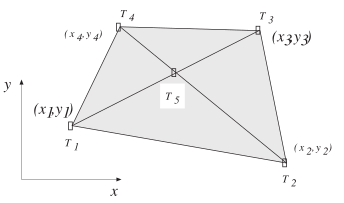
flw2qeprovides the element stiffness (conductivity) matrixKeand the element load vectorfefor a quadrilateral heat flow element.The element nodal coordinates \(x_1\), \(y_1\), \(x_2\) etc, are supplied to the function by
exandey, the element thickness \(t\) is supplied byepand the thermal conductivities (or corresponding quantities) \(k_{xx}\), \(k_{xy}\) etc are supplied byD.\[\begin{split}\begin{array}{l} \mathbf{ex} = [\, x_1 \;\; x_2 \;\; x_3 \;\; x_4 \,] \\ \mathbf{ey} = [\, y_1 \;\; y_2 \;\; y_3 \;\; y_4 \,] \end{array} \qquad \mathbf{ep} = \left[\, t \,\right] \qquad \mathbf{D} = \left[ \begin{array}{cc} k_{xx} & k_{xy} \\ k_{yx} & k_{yy} \end{array} \right]\end{split}\]If the scalar variable
eqis given in the function, the element load vector \(\mathbf{fe}\) is computed, using\[\mathbf{eq} = \left[\, Q \,\right]\]where \(Q\) is the heat supply per unit volume.
- Theory:
In computing the element matrices, a fifth degree of freedom is introduced. The location of this extra degree of freedom is defined by the mean value of the coordinates in the corner points. Four sets of element matrices are calculated using
flw2te. These matrices are then assembled and the fifth degree of freedom is eliminated by static condensation.