flw2i4e
- Purpose:
Compute element stiffness matrix for a 4 node isoparametric heat flow element.
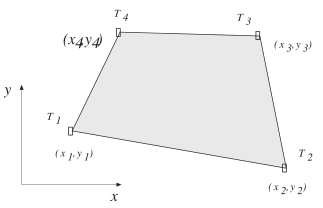
- Syntax:
Ke = flw2i4e(ex, ey, ep, D) [Ke, fe] = flw2i4e(ex, ey, ep, D, eq)- Description:
flw2i4eprovides the element stiffness (conductivity) matrixKeand the element load vectorfefor a 4 node isoparametric heat flow element.The element nodal coordinates \(x_1\), \(y_1\), \(x_2\) etc, are supplied to the function by
exandey. The element thickness \(t\) and the number of Gauss points \(n\) (\(n \times n\) integration points, \(n=1,2,3\)) are supplied to the function byepand the thermal conductivities (or corresponding quantities) \(k_{xx}\), \(k_{xy}\) etc are supplied byD.\[\begin{split}\begin{array}{l} \mathbf{ex} = [\, x_1 \;\; x_2 \;\; x_3 \;\; x_4 \,] \\ \mathbf{ey} = [\, y_1 \;\; y_2 \;\; y_3 \;\; y_4 \,] \end{array} \qquad \mathbf{ep} = [\, t \;\; n \,] \qquad \mathbf{D} = \begin{bmatrix} k_{xx} & k_{xy} \\ k_{yx} & k_{yy} \end{bmatrix}\end{split}\]If the scalar variable
eqis given in the function, the element load vector \(fe\) is computed, using\[\mathbf{eq} = [\, Q \,]\]where \(Q\) is the heat supply per unit volume.
- Theory:
The element stiffness matrix \(\mathbf{K}^e\) and the element load vector \(\mathbf{f}_l^e\), stored in
Keandfe, respectively, are computed according to\[\mathbf{K}^e = \int_A \mathbf{B}^{eT} \mathbf{D} \mathbf{B}^e t\, dA\]\[\mathbf{f}_l^e = \int_A \mathbf{N}^{eT} Q t\, dA\]with the constitutive matrix \(\mathbf{D}\) defined by
D.The evaluation of the integrals for the isoparametric 4 node element is based on a temperature approximation \(T(\xi, \eta)\), expressed in a local coordinate system in terms of the nodal variables \(T_1\), \(T_2\), \(T_3\) and \(T_4\) as
\[T(\xi, \eta) = \mathbf{N}^e \mathbf{a}^e\]where
\[\mathbf{N}^e = [\, N_1^e \;\; N_2^e \;\; N_3^e \;\; N_4^e \,] \qquad \mathbf{a}^e = [\, T_1 \;\; T_2 \;\; T_3 \;\; T_4 \,]^T\]The element shape functions are given by
\[\begin{split}N_1^e = \frac{1}{4}(1-\xi)(1-\eta) \qquad N_2^e = \frac{1}{4}(1+\xi)(1-\eta) \\ N_3^e = \frac{1}{4}(1+\xi)(1+\eta) \qquad N_4^e = \frac{1}{4}(1-\xi)(1+\eta)\end{split}\]The \(\mathbf{B}^e\)-matrix is given by
\[\begin{split}\mathbf{B}^e = \nabla \mathbf{N}^e = \begin{bmatrix} \frac{\partial}{\partial x} \\ \frac{\partial}{\partial y} \end{bmatrix} \mathbf{N}^e = (\mathbf{J}^T)^{-1} \begin{bmatrix} \frac{\partial}{\partial \xi} \\ \frac{\partial}{\partial \eta} \end{bmatrix} \mathbf{N}^e\end{split}\]where \(\mathbf{J}\) is the Jacobian matrix
\[\begin{split}\mathbf{J} = \begin{bmatrix} \frac{\partial x}{\partial \xi} & \frac{\partial x}{\partial \eta} \\ \frac{\partial y}{\partial \xi} & \frac{\partial y}{\partial \eta} \end{bmatrix}\end{split}\]Evaluation of the integrals is done by Gauss integration.