exs_flw_temp1
- Purpose:
Analysis of one-dimensional heat flow.
- Description:
Consider a wall built up of concrete and thermal insulation. The outdoor temperature is \(-17°\text{C}\) and the temperature inside is \(20°\text{C}\). At the inside of the thermal insulation there is a heat source yielding \(10\) W/m².
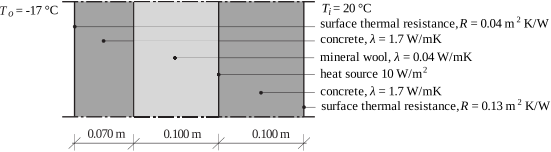

The wall is subdivided into five elements and the one-dimensional spring (analogy) element
spring1eis used. Equivalent spring stiffnesses are \(k_i=\lambda A/L\) for thermal conductivity and \(k_i=A/R\) for thermal surface resistance. Corresponding spring stiffnesses per m² of the wall are:\(k_1 =\)
\(1/0.04\)
\(=\)
\(25.0\)
W/K
\(k_2 =\)
\(1.7/0.070\)
\(=\)
\(24.3\)
W/K
\(k_3 =\)
\(0.040/0.100\)
\(=\)
\(0.4\)
W/K
\(k_4 =\)
\(1.7/0.100\)
\(=\)
\(17.0\)
W/K
\(k_5 =\)
\(1/0.13\)
\(=\)
\(7.7\)
W/K
- Example:
A global system matrix
Kand a heat flow vectorfare defined. The heat source inside the wall is considered by setting \(f_4=10\). The element matricesKeare computed usingspring1e, and the functionassemassembles the global stiffness matrix.The system of equations is solved using
solveqwith considerations to the boundary conditions inbc. The prescribed temperatures are \(a_1=-17°\text{C}\) and \(a_6=20°\text{C}\).>> Edof=[1 1 2 2 2 3; 3 3 4; 4 4 5; 5 5 6]; >> K=zeros(6); >> f=zeros(6,1); f(4)=10 f = 0 0 0 10 0 0 >> ep1=[25]; ep2=[24.3]; >> ep3=[0.4]; ep4=[17]; >> ep5=[7.7]; >> Ke1=spring1e(ep1); Ke2=spring1e(ep2); >> Ke3=spring1e(ep3); Ke4=spring1e(ep4); >> Ke5=spring1e(ep5); >> K=assem(Edof(1,:),K,Ke1); K=assem(Edof(2,:),K,Ke2); >> K=assem(Edof(3,:),K,Ke3); K=assem(Edof(4,:),K,Ke4); >> K=assem(Edof(5,:),K,Ke5); >> bc=[1 -17; 6 20]; >> [a,r]=solveq(K,f,bc) a = -17.0000 -16.4384 -15.8607 19.2378 19.4754 20.0000 r = -14.0394 0.0000 -0.0000 -0.0000 0 0.0000 4.0394The temperature values \(a_i\) in the node points are given in the vector
aand the boundary flows in the vectorr.After solving the system of equations, the heat flow through the wall is computed using
extractandspring1s:>> ed1=extract_ed(Edof(1,:),a); >> ed2=extract_ed(Edof(2,:),a); >> ed3=extract_ed(Edof(3,:),a); >> ed4=extract_ed(Edof(4,:),a); >> ed5=extract_ed(Edof(5,:),a); >> q1=spring1s(ep1,ed1) q1 = 14.0394 >> q2=spring1s(ep2,ed2) q2 = 14.0394 >> q3=spring1s(ep3,ed3) q3 = 14.0394 >> q4=spring1s(ep4,ed4) q4 = 4.0394 >> q5=spring1s(ep5,ed5) q5 = 4.0394The heat flow through the wall is \(q=14.0\) W/m² in the part of the wall to the left of the heat source, and \(q=4.0\) W/m² in the part to the right of the heat source.