exs_flw_temp1
- Purpose:
Analysis of one-dimensional heat flow.
- Description:
Consider a wall built up of concrete and thermal insulation. The outdoor temperature is \(-17°\text{C}\) and the temperature inside is \(20°\text{C}\). At the inside of the thermal insulation there is a heat source yielding \(10\) W/m².
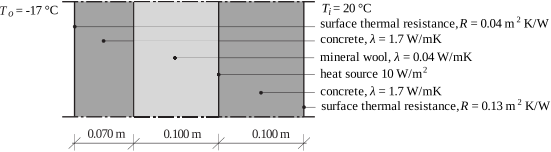

The wall is subdivided into five elements and the one-dimensional spring (analogy) element
spring1eis used. Equivalent spring stiffnesses are \(k_i=\lambda A/L\) for thermal conductivity and \(k_i=A/R\) for thermal surface resistance. Corresponding spring stiffnesses per m² of the wall are:\(k_1 =\)
\(1/0.04\)
\(=\)
\(25.0\)
W/K
\(k_2 =\)
\(1.7/0.070\)
\(=\)
\(24.3\)
W/K
\(k_3 =\)
\(0.040/0.100\)
\(=\)
\(0.4\)
W/K
\(k_4 =\)
\(1.7/0.100\)
\(=\)
\(17.0\)
W/K
\(k_5 =\)
\(1/0.13\)
\(=\)
\(7.7\)
W/K
- Example:
The computation is initialized by importing CALFEM and NumPy. A global system matrix
Kand a heat flow vectorfare defined. The heat source inside the wall is considered by setting \(f_4=10\). The element matricesKeare computed usingcfc.spring1e, and the functioncfc.assemassembles the global stiffness matrix. The system of equations is solved usingcfc.solveqwith boundary conditions. The prescribed temperatures are \(T_1=-17°\text{C}\) and \(T_6=20°\text{C}\):import numpy as np import calfem.core as cfc import calfem.utils as cfu # ----- Topology ------------------------------------------------- edof = np.array([ [1, 2], [2, 3], [3, 4], [4, 5], [5, 6] ]) # ----- Stiffness matrix K and load vector f --------------------- K = np.array(np.zeros((6, 6))) f = np.array(np.zeros((6, 1))) f[3] = 10.0 # ----- Element stiffness and element load matrices ------------- ep1 = 25 ep2 = 24.3 ep3 = 0.4 ep4 = 17 ep5 = 7.7 Ke1 = cfc.spring1e(ep1) Ke2 = cfc.spring1e(ep2) Ke3 = cfc.spring1e(ep3) Ke4 = cfc.spring1e(ep4) Ke5 = cfc.spring1e(ep5) # ----- Assemble Ke into K --------------------------------------- cfc.assem(edof[0, :], K, Ke1) cfc.assem(edof[1, :], K, Ke2) cfc.assem(edof[2, :], K, Ke3) cfc.assem(edof[3, :], K, Ke4) cfc.assem(edof[4, :], K, Ke5) # ----- Solve the system of equations ---------------------------- bc = np.array([1, 6]) bcVal = np.array([-17, 20]) a, r = cfc.solveq(K, f, bc, bcVal) cfu.disp_h2("Temperatures a:") cfu.disp_array(a, tablefmt="plain") cfu.disp_h2("Reaction flows r:") cfu.disp_array(r, tablefmt="plain")## Temperatures a: -1.7000e+01 -1.6438e+01 -1.5861e+01 1.9238e+01 1.9475e+01 2.0000e+01 ## Reaction flows r: -1.4039e+01 -5.6843e-14 -1.1546e-14 0.0000e+00 5.6843e-14 4.0394e+00The temperature values \(a_i\) at the node points are given in the vector
aand the boundary heat flows in the vectorr.After solving the system of equations, the heat flow through each element is computed using
cfc.extract_edandcfc.spring1s:ed1 = cfc.extract_ed(edof[0, :], a) ed2 = cfc.extract_ed(edof[1, :], a) ed3 = cfc.extract_ed(edof[2, :], a) ed4 = cfc.extract_ed(edof[3, :], a) ed5 = cfc.extract_ed(edof[4, :], a) q1 = cfc.spring1s(ep1, ed1) q2 = cfc.spring1s(ep2, ed2) q3 = cfc.spring1s(ep3, ed3) q4 = cfc.spring1s(ep4, ed4) q5 = cfc.spring1s(ep5, ed5) cfu.disp_h2("Element flows:") print("q1 = ") print(q1) print("q2 = ") print(q2) print("q3 = ") print(q3) print("q4 = ") print(q4) print("q5 = ") print(q5)## Element flows: q1 = 14.039386189223357 q2 = 14.039386189223451 q3 = 14.039386189223485 q4 = 4.039386189223492 q5 = 4.03938618922342The heat flow through the wall is \(q=14.0\) W/m² in the part of the wall to the left of the heat source (elements 1-3), and \(q=4.0\) W/m² in the part to the right of the heat source (elements 4-5). This demonstrates how the internal heat source affects the heat flow distribution through the wall.