exs_beam2
- Purpose:
Analysis of a plane frame.
- Description:
A frame consists of one horizontal and two vertical beams according to the figure.
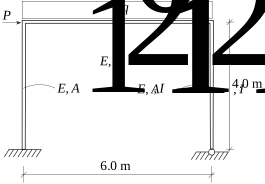
Material and geometric properties:
\(E\)
\(=\)
\(200\) GPa
\(A_1\)
\(=\)
\(2.0 \times 10^{-3}\) m²
\(I_1\)
\(=\)
\(1.6 \times 10^{-5}\) m⁴
\(A_2\)
\(=\)
\(6.0 \times 10^{-3}\) m²
\(I_2\)
\(=\)
\(5.4 \times 10^{-5}\) m⁴
\(P\)
\(=\)
\(2.0\) kN
\(q_0\)
\(=\)
\(10.0\) kN/m
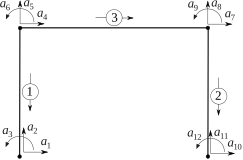
The corresponding finite element model consists of three beam elements and twelve degrees of freedom.
- Example:
A topology matrix
Edof, a global stiffness matrixKand load vectorfare defined. The element matricesKeandfeare computed by the functionbeam2e. These matrices are then assembled in the global matrices using the functionassem:>> Edof=[1 4 5 6 1 2 3; 2 7 8 9 10 11 12; 3 4 5 6 7 8 9]; >> K=zeros(12); f=zeros(12,1); f(4)=2e+3; >> E=200e9; >> A1=2e-3; A2=6e-3; >> I1=1.6e-5; I2=5.4e-5; >> ep1=[E A1 I1]; ep3=[E A2 I2]; >> ex1=[0 0]; ex2=[6 6]; ex3=[0 6]; >> ey1=[0 4]; ey2=[0 4]; ey3=[4 4]; >> eq1=[0 0]; eq2=[0 0]; eq3=[0 -10e+3]; >> Ke1=beam2e(ex1,ey1,ep1); >> Ke2=beam2e(ex2,ey2,ep1); >> [Ke3,fe3]=beam2e(ex3,ey3,ep3,eq3); >> K=assem(Edof(1,:),K,Ke1); >> K=assem(Edof(2,:),K,Ke2); >> [K,f]=assem(Edof(3,:),K,Ke3,f,fe3);The system of equations are solved considering the boundary conditions in
bc:>> bc=[1 0; 2 0; 3 0; 10 0; 11 0]; >> [a,r]=solveq(K,f,bc) a = r = 0 1.0e+004 * 0 0 0.1927 0.0075 2.8741 -0.0003 0.0445 -0.0054 0 0.0075 0.0000 -0.0003 -0.0000 0.0047 -0.0000 0 0 0 0.0000 -0.0052 -0.3927 3.1259 0The element displacements are obtained from the function
extract, and the functionbeam2scomputes the section forces and the displacements along the element:>> Ed=extract_ed(Edof,a); >> [es1,edi1]=beam2s(ex1,ey1,ep1,Ed(1,:),eq1,21) es1 = edi1 = 1.0e+004 * 0.0003 0.0075 0.0003 0.0065 -2.8741 0.1927 0.8152 . . -2.8741 0.1927 0.7767 0.0000 0.0000 . . . -2.8741 0.1927 0.0445 >> [es2,edi2]=beam2s(ex2,ey2,ep1,Ed(2,:),eq2,21) es2 = edi2 = 1.0e+004 * 0.0003 0.0075 0.0003 0.0084 -3.1259 -0.3927 -1.5707 . . -3.1259 -0.3927 -1.4922 0.0000 0.0000 . . . -3.1259 -0.3927 -0.0000 >> [es3,edi3]=beam2s(ex3,ey3,ep3,Ed(3,:),eq3,21) es3 = edi3 = 1.0e+004 * 0.0075 -0.0003 0.0075 -0.0019 -0.3927 -2.8741 -0.8152 . . -0.3927 -2.5741 0.0020 0.0075 -0.0003 . . . -0.3927 3.1259 -1.5707A displacement diagram is displayed using the function
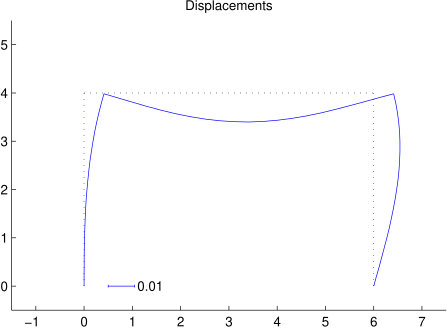
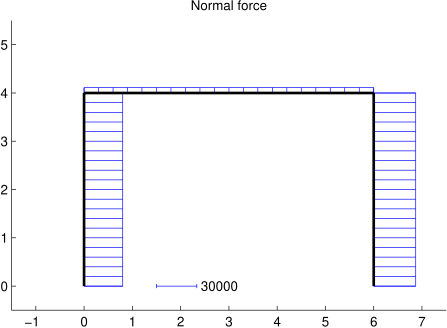
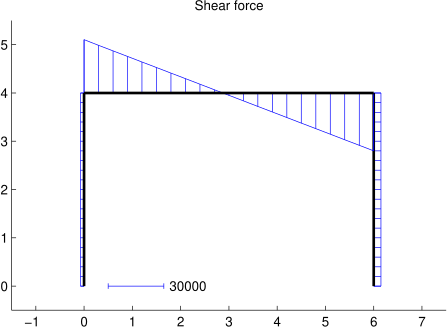
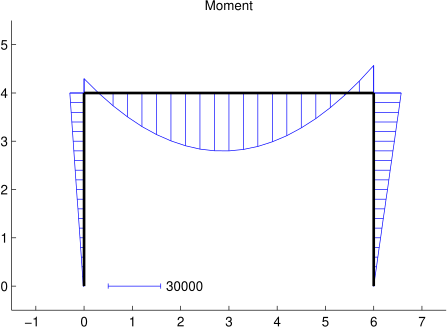
dispbeam2and section force diagrams using the functionsecforce2:>> figure(1) >> plotpar=[2 1 0]; >> eldraw2(ex1,ey1,plotpar); >> eldraw2(ex2,ey2,plotpar); >> eldraw2(ex3,ey3,plotpar); >> sfac=scalfact2(ex3,ey3,Ed(3,:),0.1); >> plotpar=[1 2 1]; >> dispbeam2(ex1,ey1,edi1,plotpar,sfac); >> dispbeam2(ex2,ey2,edi2,plotpar,sfac); >> dispbeam2(ex3,ey3,edi3,plotpar,sfac); >> axis([-1.5 7.5 -0.5 5.5]); >> scalgraph2(sfac,[1e-2 0.5 0]); >> title('Displacements') >> figure(2) >> plotpar=[2 1]; >> sfac=scalfact2(ex1,ey1,es1(:,1),0.2); >> secforce2(ex1,ey1,es1(:,1),plotpar,sfac); >> secforce2(ex2,ey2,es2(:,1),plotpar,sfac); >> secforce2(ex3,ey3,es3(:,1),plotpar,sfac); >> axis([-1.5 7.5 -0.5 5.5]); >> scalgraph2(sfac,[3e4 1.5 0]); >> title('Normal force') >> figure(3) >> plotpar=[2 1]; >> sfac=scalfact2(ex3,ey3,es3(:,2),0.2); >> secforce2(ex1,ey1,es1(:,2),plotpar,sfac); >> secforce2(ex2,ey2,es2(:,2),plotpar,sfac); >> secforce2(ex3,ey3,es3(:,2),plotpar,sfac); >> axis([-1.5 7.5 -0.5 5.5]); >> scalgraph2(sfac,[3e4 0.5 0]); >> title('Shear force') >> figure(4) >> plotpar=[2 1]; >> sfac=scalfact2(ex3,ey3,es3(:,3),0.2); >> secforce2(ex1,ey1,es1(:,3),plotpar,sfac); >> secforce2(ex2,ey2,es2(:,3),plotpar,sfac); >> secforce2(ex3,ey3,es3(:,3),plotpar,sfac); >> axis([-1.5 7.5 -0.5 5.5]); >> scalgraph2(sfac,[3e4 0.5 0]); >> title('Moment')