exs_beam1
- Purpose:
Analysis of a simply supported beam.
- Description:
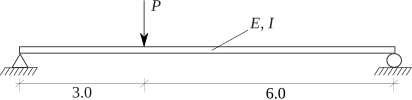
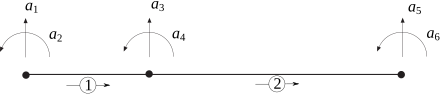
Consider a beam with the length \(9.0\) m. The beam is simply supported and loaded by a point load \(P=10000\) N applied at a point \(3.0\) m from the left support. The corresponding computational model has six degrees of freedom and consists of two beam elements with four degrees of freedom. The beam has Young’s modulus \(E=210\) GPa and moment of inertia \(I=2510 \times 10^{-8}\) m⁴.
- Example:
The element topology is defined by the topology matrix:
>>  Edof=[1  1  2  3  4;
          2  3  4  5  6];
The system matrices, i.e. the stiffness matrix
Kand the load vectorf, are defined by:>> K=zeros(6); f=zeros(6,1); f(3)=-10000;The element property vector
ep, the element coordinate vectorsex1andex2, and the element stiffness matricesKe1andKe2, are generated:>> E=210e9; I=2510e-8; ep=[E A I]; >> ex1=[0 3]; ex2=[3 9]; >> Ke1=beam1e(ex1,ep) Ke1 = 1.0e+06 * 2.3427 3.5140 -2.3427 3.5140 3.5140 7.0280 -3.5140 3.5140 -2.3427 -3.5140 2.3427 -3.5140 3.5140 3.5140 -3.5140 7.0280 >> Ke2=beam1e(ex2,ep) Ke2 = 1.0e+06 * 0.2928 0.8785 -0.2928 0.8785 0.8785 3.5140 -0.8785 1.7570 -0.2928 -0.8785 0.2928 -0.8785 0.8785 1.7570 -0.8785 3.5140Based on the topology information, the global stiffness matrix can be generated by assembling the element stiffness matrices:
>> K=assem(Edof(1,:),K,Ke1);
>> K=assem(Edof(2,:),K,Ke2);
Finally, the solution can be calculated by defining the boundary conditions in
bcand solving the system of equations. Displacementsaand support forcesrare computed by the functionsolveq:>> bc=[1 0; 5 0]; [a,r]=solveq(K,f,bc)The section forces
esare calculated from element displacementsEd:>> Ed=extract_ed(Edof,a); >> [es1,edi1]=beam1s(ex1,ep,Ed(1,:),eq,6) >> [es2,edi2]=beam1s(ex2,ep,Ed(2,:),eq,11)Results:
a =                      r =
         0                   1.0e+003 *
   -0.0095
   -0.0228                     6.6667
   -0.0038                    -0.0000
         0                    -0.0000
    0.0076                    -0.0000
                               3.3333
                                    0

es1 =                        edi1 =

  1.0e+004 *                           0
                                 -0.0093
   -0.6667    0.0000             -0.0173
   -0.6667    0.6667             -0.0228
   -0.6667    1.3333
   -0.6667    2.0000

es2 =                        edi2 =

 1.0e+004 *                      -0.0228
                                 -0.0248
    0.3333    2.0000             -0.0236
    0.3333    1.6667             -0.0199
    0.3333    1.3333             -0.0143
    0.3333    1.0000             -0.0075
    0.3333    0.6667             -0.0000
    0.3333    0.3333
    0.3333   -0.0000
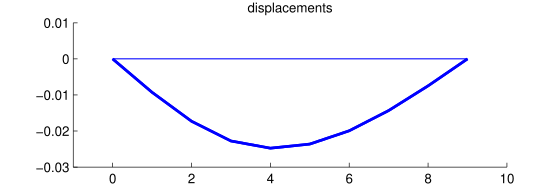
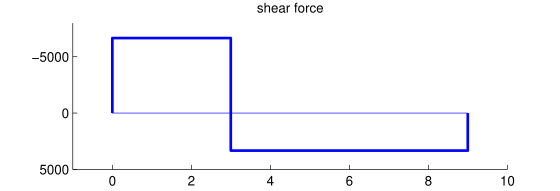
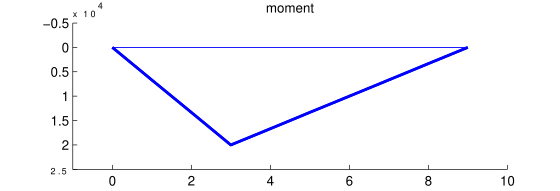
A displacement diagram and section force diagrams are displayed using the function
plot:figure(1) hold on; plot([0 9],[0 0]); c=plot([0,0:1:3,3:1:9,9],[0;edi1(:,1);edi2(:,1);0]); set(c,'LineWidth',[2]); axis([-1 10 -0.03 0.01]); title('displacements') figure(2) hold on; plot([0 9],[0 0]); c=plot([0,0:1:3,3:1:9,9],[0;es1(:,1);es2(:,1);0]); set(c,'LineWidth',[2]); axis([-1 10 -8000 5000]); set(gca, 'YDir','reverse'); title('shear force') figure(3) hold on; plot([0 9],[0 0]); c=plot([0,0:1:3,3:1:9,9],[0;es1(:,2);es2(:,2);0]); set(c,'LineWidth',[2]); axis([-1 10 -5000 25000]); set(gca, 'YDir','reverse'); title('moment')