exs_bar2
- Purpose:
Analysis of a plane truss.
- Description:
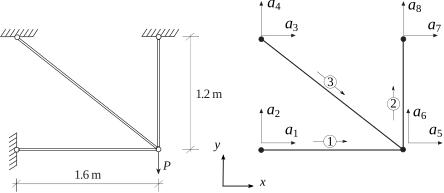
Consider a plane truss consisting of three bars with the properties \(E=200\) GPa, \(A_1=6.0 \times 10^{-4}\) m², \(A_2=3.0 \times 10^{-4}\) m² and \(A_3=10.0 \times 10^{-4}\) m², and loaded by a single force \(P=80\) kN. The corresponding finite element model consists of three elements and eight degrees of freedom.
- Example:
The topology is defined by the matrix:
>> Edof=[1   1  2  5  6;
         2   5  6  7  8;
         3   3  4  5  6];
The stiffness matrix
Kand the load vectorf, are defined by:>> K=zeros(8); f=zeros(8,1); f(6)=-80e3;The element property vectors
ep1,ep2andep3are defined by:>> E=2.0e11; >> A1=6.0e-4; A2=3.0e-4; A3=10.0e-4; >> ep1=[E A1]; ep2=[E A2]; ep3=[E A3];And the element coordinate vectors
ex1,ex2,ex3,ey1,ey2andey3by:>> ex1=[0 1.6]; ex2=[1.6 1.6]; ex3=[0 1.6]; >> ey1=[0 0]; ey2=[0 1.2]; ey3=[1.2 0];The element stiffness matrices
Ke1,Ke2andKe3are computed usingbar2e:>> Ke1=bar2e(ex1,ey1,ep1) Ke1 = 1.0e+007 * 7.5000 0 -7.5000 0 0 0 0 0 -7.5000 0 7.5000 0 0 0 0 0 >> Ke2=bar2e(ex2,ey2,ep2) Ke2 = 1.0e+007 * 0 0 0 0 0 5.0000 0 -5.0000 0 0 0 0 0 -5.0000 0 5.0000 >> Ke3=bar2e(ex3,ey3,ep3) Ke3 = 1.0e+007 * 6.4000 -4.8000 -6.4000 4.8000 -4.8000 3.6000 4.8000 -3.6000 -6.4000 4.8000 6.4000 -4.8000 4.8000 -3.6000 -4.8000 3.6000Based on the topology information, the global stiffness matrix can be generated by assembling the element stiffness matrices:
>> K=assem(Edof(1,:),K,Ke1);
>> K=assem(Edof(2,:),K,Ke2);
>> K=assem(Edof(3,:),K,Ke3)

K =

  1.0e+008 *

  Columns 1 through 7

    0.7500         0         0         0   -0.7500         0         0
         0         0         0         0         0         0         0
         0         0    0.6400   -0.4800   -0.6400    0.4800         0
         0         0   -0.4800    0.3600    0.4800   -0.3600         0
   -0.7500         0   -0.6400    0.4800    1.3900   -0.4800         0
         0         0    0.4800   -0.3600   -0.4800    0.8600         0
         0         0         0         0         0         0         0
         0         0         0         0         0   -0.5000         0

  Column 8

         0
         0
         0
         0
         0
   -0.5000
         0
    0.5000
Considering the prescribed displacements in
bc, the system of equations is solved using the functionsolveq, yielding displacementsaand support forcesr:>> bc= [1 0;2 0;3 0;4 0;7 0;8 0]; >> [a,r]=solveq(K,f,bc) a = 1.0e-002 * 0 0 0 0 -0.0398 -0.1152 0 0 r = 1.0e+004 * 2.9845 0 -2.9845 2.2383 0.0000 0.0000 0 5.7617The vertical displacement at the point of loading is 1.15 mm. The section forces
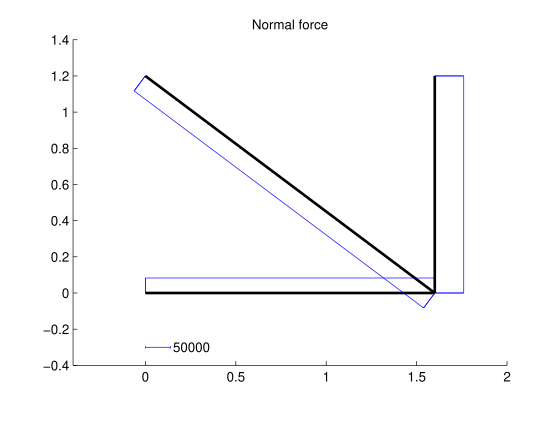
es1,es2andes3are calculated usingbar2sfrom element displacementsed1,ed2anded3obtained usingextract:>> ed1=extract_ed(Edof(1,:),a); >> es1=bar2s(ex1,ey1,ep1,ed1) es1 = 1.0e+004 * -2.9845 -2.9845 >> ed2=extract_ed(Edof(2,:),a); >> es2=bar2s(ex2,ey2,ep2,ed2) es2 = 1.0e+004 * 5.7617 5.7617 >> ed3=extract_ed(Edof(3,:),a); >> es3=bar2s(ex3,ey3,ep3,ed3) es3 = 1.0e+004 * 3.7306 3.7306The normal forces are \(N_1=-29.84\) kN, \(N_2=57.62\) kN and \(N_3=37.31\) kN.
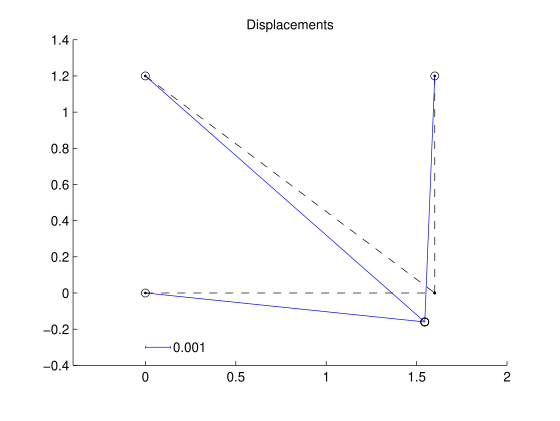
A displacement diagram is displayed using the function
eldisp2and normal force diagram using the functionsecforce2:>> figure(1) >> plotpar=[2 1 0]; >> eldraw2(ex1,ey1,plotpar); >> eldraw2(ex2,ey2,plotpar); >> eldraw2(ex3,ey3,plotpar); >> sfac=scalfact2(ex1,ey1,ed1,0.1); >> plotpar=[1 2 1]; >> eldisp2(ex1,ey1,ed1,plotpar,sfac); >> eldisp2(ex2,ey2,ed2,plotpar,sfac); >> eldisp2(ex3,ey3,ed3,plotpar,sfac); >> axis([-0.4 2.0 -0.4 1.4]); >> scalgraph2(sfac,[1e-3 0 -0.3]); >> title('Displacements') >> figure(2) >> plotpar=[2 1]; >> sfac=scalfact2(ex1,ey1,N2(:,1),0.1); >> secforce2(ex1,ey1,N1(:,1),plotpar,sfac); >> secforce2(ex2,ey2,N2(:,1),plotpar,sfac); >> secforce2(ex3,ey3,N3(:,1),plotpar,sfac); >> axis([-0.4 2.0 -0.4 1.4]); >> scalgraph2(sfac,[5e4 0 -0.3]); >> title('Normal force')