exs_bar2_l
- Purpose:
Analysis of a plane truss.
- Description:
Consider a plane truss, loaded by a single force \(P=0.5\) MN.
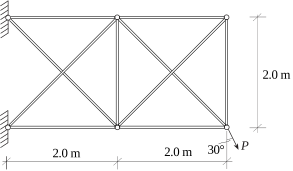
The corresponding finite element model consists of ten elements and twelve degrees of freedom.
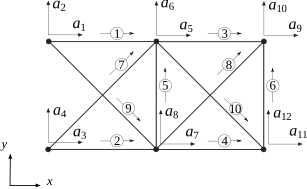
Material properties:
Cross-sectional area: \(A=25.0 \times 10^{-4}\) m²
Young’s modulus: \(E=2.10 \times 10^{5}\) MPa
- Example:
The topology is defined by the matrix:
>> Edof=[1   1  2  5  6;
         2   3  4  7  8;
         3   5  6  9 10;
         4   7  8 11 12;
         5   7  8  5  6;
         6  11 12  9 10;
         7   3  4  5  6;
         8   7  8  9 10;
         9   1  2  7  8;
        10   5  6 11 12];
A global stiffness matrix
Kand a load vectorfare defined. The load \(P\) is divided into x and y components and inserted in the load vectorf:>> K=zeros(12); >> f=zeros(12,1); f(11)=0.5e6*sin(pi/6); f(12)=-0.5e6*cos(pi/6);The element matrices
Keare computed by the functionbar2e. These matrices are then assembled in the global stiffness matrix using the functionassem:>> A=25.0e-4; E=2.1e11; ep=[E A]; >> Ex=[0 2; 0 2; 2 4; 2 4; 2 2; 4 4; 0 2; 2 4; 0 2; 2 4]; >> Ey=[2 2; 0 0; 2 2; 0 0; 0 2; 0 2; 0 2; 0 2; 2 0; 2 0];All the element matrices are computed and assembled in the loop:
>> for i=1:10
      Ke=bar2e(Ex(i,:),Ey(i,:),ep);
      K=assem(Edof(i,:),K,Ke);
   end;
The displacements in
aand the support forces inrare computed by solving the system of equations considering the boundary conditions inbc:>> bc=[1 0;2 0;3 0;4 0]; >> [a,r]=solveq(K,f,bc) a = 0 0 0 0 0.0024 -0.0045 -0.0016 -0.0042 0.0030 -0.0107 -0.0017 -0.0113 r = 1.0e+005 * -8.6603 2.4009 6.1603 1.9293 0.0000 -0.0000 -0.0000 -0.0000 0.0000 0.0000 0.0000 0.0000The displacement at the point of loading is \(-1.7 \times 10^{-3}\) m in the x-direction and \(-11.3 \times 10^{-3}\) m in the y-direction. At the upper support the horizontal force is \(-0.866\) MN and the vertical \(0.240\) MN. At the lower support the forces are \(0.616\) MN and \(0.193\) MN, respectively.
Normal forces are evaluated from element displacements. These are obtained from the global displacements
ausing the functionextract_ed. The normal forces are evaluated using the functionbar2s:ed=extract_ed(Edof,a); >> for i=1:10 es=bar2s(Ex(i,:),Ey(i,:),ep,ed(i,:)); N(i,:)=es(1); endThe obtained normal forces are:
>> N

N =

  1.0e+005 *

    6.2594
   -4.2310
    1.7064
   -0.1237
   -0.6945
    1.7064
   -2.7284
   -2.4132
    3.3953
    3.7105
The largest normal force \(N=0.626\) MN is obtained in element 1 and is equivalent to a normal stress \(\sigma=250\) MPa.
To reduce the quantity of input data, the element coordinate matrices
ExandEycan alternatively be created from a global coordinate matrixCoordand a global topology matrixDofusing the functioncoordxtr:>> Coord=[0 2; 0 0; 2 2; 2 0; 4 2; 4 0]; >> Dof=[ 1 2; 3 4; 5 6; 7 8; 9 10; 11 12]; >> [ex,ey]=coordxtr(Edof,Coord,Dof,2);