exs_bar2
- Purpose:
Analysis of a plane truss.
- Description:
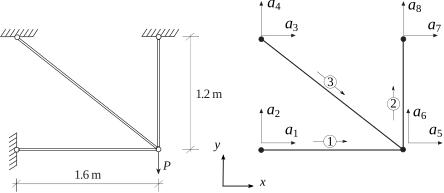
Consider a plane truss consisting of three bars with the properties \(E=200\) GPa, \(A_1=6.0 \times 10^{-4}\) m², \(A_2=3.0 \times 10^{-4}\) m² and \(A_3=10.0 \times 10^{-4}\) m², and loaded by a single force \(P=80\) kN. The corresponding finite element model consists of three elements and eight degrees of freedom.
- Example:
The computation is initialized by importing CALFEM and NumPy and defining the element topology matrix containing only the degrees of freedom for each element:
import numpy as np
import calfem.core as cfc
import calfem.utils as cfu
import calfem.vis_mpl as cfv

edof = np.array([
    [1, 2, 5, 6],
    [5, 6, 7, 8],
    [3, 4, 5, 6]
])
The global stiffness matrix
Kand the load vectorfare initialized. The load of 80 kN is applied in the negative y-direction at DOF 6:K = np.array(np.zeros((8, 8))) f = np.array(np.zeros((8, 1))) f[5] = -80e3The element property vectors
ep1,ep2andep3are defined byE = 2.0e11 # (N/m^2) A1 = 6.0e-4 # (m^2) A2 = 3.0e-4 # (m^2) A3 = 10.0e-4 # (m^2) ep1 = [E, A1] ep2 = [E, A2] ep3 = [E, A3]and the element coordinate vectors
ex1,ex2,ex3,ey1,ey2andey3byex1 = np.array([0.0, 1.6]) ex2 = np.array([1.6, 1.6]) ex3 = np.array([0.0, 1.6]) ey1 = np.array([0.0, 0.0]) ey2 = np.array([0.0, 1.2]) ey3 = np.array([1.2, 0.0])The element stiffness matrices
Ke1,Ke2andKe3are computed usingbar2e:Ke1 = cfc.bar2e(ex1, ey1, ep1) Ke2 = cfc.bar2e(ex2, ey2, ep2) Ke3 = cfc.bar2e(ex3, ey3, ep3) Ke1 = cfc.bar2e(ex1, ey1, ep1) Ke2 = cfc.bar2e(ex2, ey2, ep2) Ke3 = cfc.bar2e(ex3, ey3, ep3) cfu.disp_h2("Ke1") cfu.disp_array(Ke1, tablefmt='plain') cfu.disp_h2("Ke2") cfu.disp_array(Ke2, tablefmt='plain') cfu.disp_h2("Ke3") cfu.disp_array(Ke3, tablefmt='plain')## Ke1 7.5000e+07 0.0000e+00 -7.5000e+07 0.0000e+00 0.0000e+00 0.0000e+00 0.0000e+00 0.0000e+00 -7.5000e+07 0.0000e+00 7.5000e+07 0.0000e+00 0.0000e+00 0.0000e+00 0.0000e+00 0.0000e+00 ## Ke2 0.0000e+00 0.0000e+00 0.0000e+00 0.0000e+00 0.0000e+00 5.0000e+07 0.0000e+00 -5.0000e+07 0.0000e+00 0.0000e+00 0.0000e+00 0.0000e+00 0.0000e+00 -5.0000e+07 0.0000e+00 5.0000e+07 ## Ke3 6.4000e+07 -4.8000e+07 -6.4000e+07 4.8000e+07 -4.8000e+07 3.6000e+07 4.8000e+07 -3.6000e+07 -6.4000e+07 4.8000e+07 6.4000e+07 -4.8000e+07 4.8000e+07 -3.6000e+07 -4.8000e+07 3.6000e+07Based on the topology information, the global stiffness matrix can be generated by assembling the element stiffness matrices.
K = cfc.assem(edof[0, :], K, Ke1)
K = cfc.assem(edof[1, :], K, Ke2)
K = cfc.assem(edof[2, :], K, Ke3)

cfu.disp_h2("Stiffness matrix K (N/m):")
cfu.disp_array(K, tablefmt='plain')
## Stiffness matrix K (N/m): 7.5000e+07 0.0000e+00 0.0000e+00 0.0000e+00 -7.5000e+07 0.0000e+00 0.0000e+00 0.0000e+00 0.0000e+00 0.0000e+00 0.0000e+00 0.0000e+00 0.0000e+00 0.0000e+00 0.0000e+00 0.0000e+00 0.0000e+00 0.0000e+00 6.4000e+07 -4.8000e+07 -6.4000e+07 4.8000e+07 0.0000e+00 0.0000e+00 0.0000e+00 0.0000e+00 -4.8000e+07 3.6000e+07 4.8000e+07 -3.6000e+07 0.0000e+00 0.0000e+00 -7.5000e+07 0.0000e+00 -6.4000e+07 4.8000e+07 1.3900e+08 -4.8000e+07 0.0000e+00 0.0000e+00 0.0000e+00 0.0000e+00 4.8000e+07 -3.6000e+07 -4.8000e+07 8.6000e+07 0.0000e+00 -5.0000e+07 0.0000e+00 0.0000e+00 0.0000e+00 0.0000e+00 0.0000e+00 0.0000e+00 0.0000e+00 0.0000e+00 0.0000e+00 0.0000e+00 0.0000e+00 0.0000e+00 0.0000e+00 -5.0000e+07 0.0000e+00 5.0000e+07The system of equations \(\boldsymbol{Ka}=\boldsymbol{f}\) is solved by specifying the boundary conditions and using
solveq():bc_dofs = np.array([1, 2, 3, 4, 7, 8]) bc_vals = np.array([0.0, 0.0, 0.0, 0.0, 0.0, 0.0]) a, r = cfc.solveq(K, f, bc_dofs, bc_vals) cfu.disp_h2("Displacements a (m):") cfu.disp_array(a) cfu.disp_h2("Reaction forces r (N):") cfu.disp_array(r)## Displacements a (m): +-------------+ | 0.0000e+00 | | 0.0000e+00 | | 0.0000e+00 | | 0.0000e+00 | | -3.9793e-04 | | -1.1523e-03 | | 0.0000e+00 | | 0.0000e+00 | +-------------+ ## Reaction forces r (N): +-------------+ | 2.9845e+04 | | 0.0000e+00 | | -2.9845e+04 | | 2.2383e+04 | | 0.0000e+00 | | 0.0000e+00 | | 0.0000e+00 | | 5.7617e+04 | +-------------+The vertical displacement at the point of loading is 1.15 mm. The element forces are calculated by extracting element displacements and computing stresses:
ed1 = cfc.extract_ed(edof[0, :], a)
ed2 = cfc.extract_ed(edof[1, :], a)
ed3 = cfc.extract_ed(edof[2, :], a)

es1 = cfc.bar2s(ex1, ey1, ep1, ed1)
es2 = cfc.bar2s(ex2, ey2, ep2, ed2)
es3 = cfc.bar2s(ex3, ey3, ep3, ed3)

cfu.disp_h2("Element normal forces (N):")

cfu.disp("N1")
cfu.disp_array(es1)
cfu.disp("N2")
cfu.disp_array(es2)
cfu.disp("N3")
cfu.disp_array(es3)
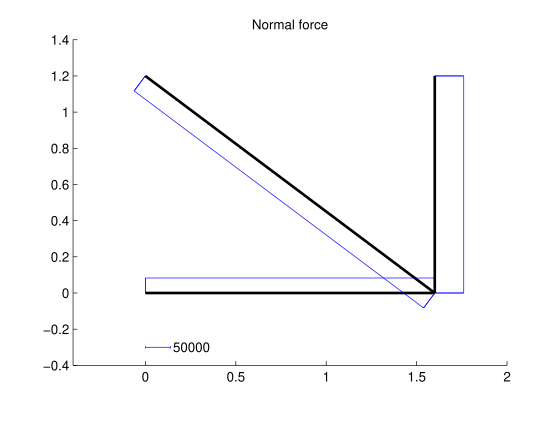
## Element normal forces (N): N1 +-------------+ | -2.9845e+04 | | -2.9845e+04 | +-------------+ N2 +------------+ | 5.7617e+04 | | 5.7617e+04 | +------------+ N3 +------------+ | 3.7306e+04 | | 3.7306e+04 | +------------+The normal forces are \(N_1=-29.84\) kN (compression), \(N_2=57.62\) kN (tension) and \(N_3=37.31\) kN (tension).
Visualization of the results can be performed using CALFEM’s visualization functions:
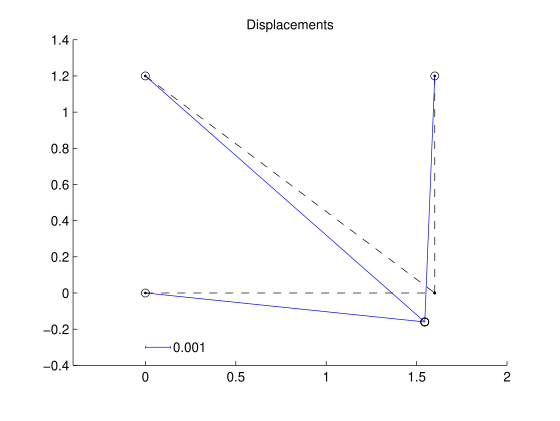
plotpar1 = [2, 1, 0] sfac = cfv.scalfact2(ex3, ey3, ed1, 0.1) print("sfac =", sfac) cfv.figure(1) cfv.eldraw2(ex1, ey1, plotpar1) cfv.eldraw2(ex2, ey2, plotpar1) cfv.eldraw2(ex3, ey3, plotpar1) plotpar2 = [1, 2, 1] cfv.eldisp2(ex1, ey1, ed1, plotpar2, sfac) cfv.eldisp2(ex2, ey2, ed2, plotpar2, sfac) cfv.eldisp2(ex3, ey3, ed3, plotpar2, sfac) cfv.axis([-0.4, 2.0, -0.4, 1.4]) plotpar3 = 2 cfv.scalgraph2(sfac, [1e-3, 0, -0.3], plotpar3) cfv.title("Displacements") # ----- Draw normal force diagram -------------------------------- plotpar = [2, 1] sfac = cfv.scalfact2(ex1, ey1, es2[:, 0], 0.1) cfv.figure(2) cfv.secforce2(ex1, ey1, es1[:, 0], plotpar, sfac) cfv.secforce2(ex2, ey2, es2[:, 0], plotpar, sfac) cfv.secforce2(ex3, ey3, es3[:, 0], plotpar, sfac) cfv.axis([-0.4, 2.0, -0.4, 1.4]) cfv.scalgraph2(sfac, [5e4, 0, -0.3], plotpar3) cfv.title("Normal force") cfv.show_and_wait()- Figures: