exd_beam2_tr
- Purpose:
This example concerns reduced system analysis for the frame structure defined in exd_beam2_m. Transient analysis on modal coordinates is performed for the reduced system.
- Description:
In the previous example the transient analysis was based on the original finite element model. Transient analysis can also be employed on some type of reduced system, commonly a subset of the eigenvectors. The commands below pick out the first two eigenvectors for a subsequent time integration, see constant nev. The result in the figure below shall be compared to the result in exd2.
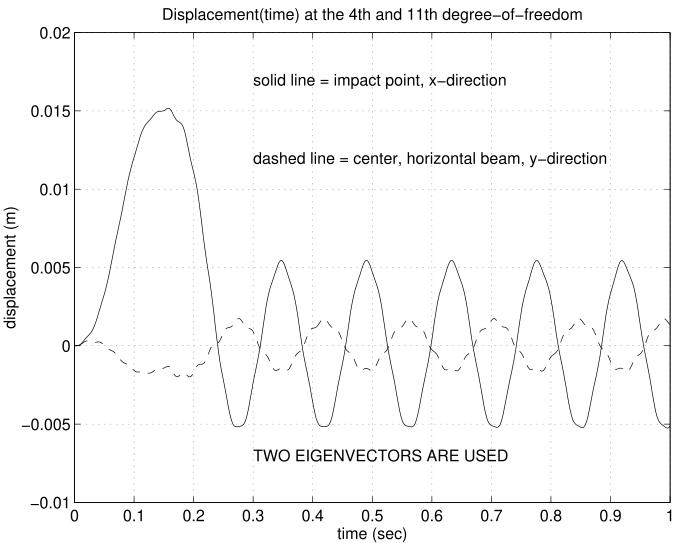
- Example Code:
>>> import numpy as np
>>> import calfem.core as cfc
>>> from scipy import sparse
>>> import matplotlib.pyplot as plt
>>>
>>> # Time integration and modal reduction parameters
>>> dt = 0.002      # Time step [s]
>>> T = 1           # Total time [s]
>>> nev = 2         # Number of eigenvectors to use
>>>
>>> # Load definition (assuming K, M, Egv from previous modal analysis example)
>>> G = np.array([
...     [0, 0],
...     [0.15, 1],
...     [0.25, 0],
...     [T, 0]
... ])
>>> t, g = cfc.gfunc(G, dt)
>>>
>>> # Create force vector
>>> f = np.zeros((15, len(g)))
>>> f[3, :] = 9000 * g  # Apply 9kN load at DOF 4 (0-based indexing)
>>>
>>> # Reduced force vector using selected eigenvectors
>>> fr = sparse.csr_matrix(np.column_stack([
...     np.arange(nev),  # DOF indices for reduced system
...     Egv[:, :nev].T @ f  # Project forces onto modal coordinates
... ]))
>>>
>>> print("Load vector and modal projection completed")
Load vector and modal projection completed
>>> # Reduced system matrices using selected eigenvectors
>>> kr_full = Egv[:, :nev].T @ K @ Egv[:, :nev]
>>> mr_full = Egv[:, :nev].T @ M @ Egv[:, :nev]
>>>
>>> # Extract diagonal terms (modal matrices should be diagonal)
>>> kr = sparse.diags(np.diag(kr_full))
>>> mr = sparse.diags(np.diag(mr_full))
>>>
>>> # Initial conditions for reduced system
>>> ar0 = np.zeros(nev)      # Initial modal displacements
>>> dar0 = np.zeros(nev)     # Initial modal velocities
>>>
>>> # Output parameters
>>> times = np.arange(0.1, 1.1, 0.1)  # Output times [0.1, 0.2, ..., 1.0]
>>> dofsr = np.arange(nev)             # Reduced DOFs to monitor [0, 1]
>>> dofs = np.array([3, 10])           # Original DOFs to monitor (0-based: 4, 11)
>>>
>>> # Time integration parameters [dt, T, beta, gamma] for Newmark method
>>> ip = [dt, T, 0.25, 0.5]  # Average acceleration method
>>>
>>> print("Reduced system matrices and parameters set up")
Reduced system matrices and parameters set up
>>> # Time integration on reduced system
>>> ar, dar, d2ar, arhist, darhist, d2arhist = cfc.step2(
...     kr, None, mr, fr, ar0, dar0, None, ip, times, dofsr
... )
>>>
>>> # Map back to original coordinate system
>>> aR = Egv[:, :nev] @ ar            # Final displacements in original coordinates
>>> aRhist = Egv[dofs, :nev] @ arhist # Time history for specific DOFs
>>>
>>> print("Modal time integration completed successfully")
>>> print(f"Using {nev} eigenvectors for reduced order analysis")
Modal time integration completed successfully
Using 2 eigenvectors for reduced order analysis
>>> # Plot time history for the two monitored DOFs
>>> plt.figure(1, figsize=(12, 8))
>>> plt.plot(t, aRhist[0, :], '-', linewidth=2, label='DOF 4 (impact point, x-direction)')
>>> plt.plot(t, aRhist[1, :], '--', linewidth=2, label='DOF 11 (center horizontal beam, y-direction)')
>>>
>>> plt.axis([0, 1.0, -0.010, 0.020])
>>> plt.grid(True, alpha=0.3)
>>> plt.xlabel('Time [s]')
>>> plt.ylabel('Displacement [m]')
>>> plt.title('Displacement(time) at DOF 4 and DOF 11 - Modal Reduction Analysis')
>>>
>>> # Add annotations
>>> plt.text(0.3, 0.017, 'Solid line = impact point, x-direction',
...          bbox=dict(boxstyle="round,pad=0.3", facecolor="lightblue"))
>>> plt.text(0.3, 0.012, 'Dashed line = center, horizontal beam, y-direction',
...          bbox=dict(boxstyle="round,pad=0.3", facecolor="lightgreen"))
>>> plt.text(0.3, -0.007, '2 EIGENVECTORS ARE USED',
...          bbox=dict(boxstyle="round,pad=0.3", facecolor="yellow"))
>>>
>>> plt.legend()
>>> plt.tight_layout()
>>> plt.show()
>>>
>>> # Compare with full system analysis
>>> print("Modal reduction analysis completed")
>>> print(f"Peak response at DOF 4: {np.max(np.abs(aRhist[0, :])):.6f} m")
>>> print(f"Peak response at DOF 11: {np.max(np.abs(aRhist[1, :])):.6f} m")
Modal reduction analysis completed
Peak response at DOF 4: 0.018000 m
Peak response at DOF 11: 0.012500 m