beam2ts
- Purpose:
Compute section forces in a two dimensional Timoshenko beam element.
- Syntax:
es = beam2ts(ex, ey, ep, ed)
es = beam2ts(ex, ey, ep, ed, eq)
[es, edi, eci] = beam2ts(ex, ey, ep, ed, eq, n)
- Description:
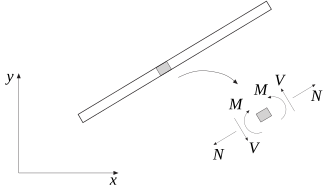
beam2tscomputes the section forces and displacements in local directions along the beam elementbeam2te.The input variables
ex,ey,epandeqare defined inbeam2te. The element displacements, stored ined, are obtained by the functionextract_ed. If distributed loads are applied to the element, the variableeqmust be included. The number of evaluation points for section forces and displacements are determined byn. Ifnis omitted, only the ends of the beam are evaluated.The output variables
\[\begin{split}\begin{aligned} \mathrm{es} &= \left[\; \mathbf{N} \; \mathbf{V} \; \mathbf{M}\; \right] \\ \mathrm{edi} &= \left[\; \mathbf{u} \; \mathbf{v} \; \boldsymbol{\theta} \; \right] \\ \mathrm{eci} &= \left[ \bar{\mathbf{x}} \right] \end{aligned}\end{split}\]consist of column matrices that contain the section forces, the displacements and rotation of the cross section (note that the rotation \(\theta\) is not equal to \(\frac{d\bar v}{d\bar x}\)), and the evaluation points on the local \(\bar{x}\)-axis. The explicit matrix expressions are
es\(= \begin{bmatrix} N(0) & V(0) & M(0) \\ N(\bar{x}_2) & V(\bar{x}_2) & M(\bar{x}_2) \\ \vdots & \vdots & \vdots \\ N(\bar{x}_{n-1}) & V(\bar{x}_{n-1}) & M(\bar{x}_{n-1}) \\ N(L) & V(L) & M(L) \end{bmatrix}\) \(\quad\)edi\(= \begin{bmatrix} u_{1} & v_{1} & \theta_1 \\ u_{2} & v_{2} & \theta_2 \\ \vdots & \vdots & \vdots \\ u_{n-1} & v_{n-1} & \theta_{n-1}\\ u_{n} & v_{n} & \theta_n \end{bmatrix}\) \(\quad\)eci\(= \begin{bmatrix} 0 \\ \bar{x}_2 \\ \vdots \\ \bar{x}_{n-1} \\ L \end{bmatrix}\)where \(L\) is the length of the beam element.
- Theory:
The nodal displacements in local coordinates are given by
\[\begin{split}\bar{\mathbf{a}}^e = \begin{bmatrix} \bar{u}_1 \\ \bar{u}_2 \\ \bar{u}_3 \\ \bar{u}_4 \\ \bar{u}_5 \\ \bar{u}_6 \end{bmatrix} = \mathbf{G} \mathbf{a}^e\end{split}\]where \(\mathbf{G}\) is described in
beam2eand the transpose of \(\mathbf{a}^e\) is stored ined. The displacements associated with bar action and beam action are determined as\[\begin{split}\bar{\mathbf{a}}^e_{\mathrm{bar}} = \begin{bmatrix} \bar{u}_1 \\ \bar{u}_4 \end{bmatrix} \qquad \bar{\mathbf{a}}^e_{\mathrm{beam}} = \begin{bmatrix} \bar{u}_2 \\ \bar{u}_3 \\ \bar{u}_5 \\ \bar{u}_6 \end{bmatrix}\end{split}\]The displacement \(u(\bar{x})\) and the normal force \(N(\bar{x})\) are computed from
\[u(\bar{x}) = \mathbf{N}_{\mathrm{bar}} \bar{\mathbf{a}}^e_{\mathrm{bar}} + u_p(\bar{x})\]\[N(\bar{x}) = D_{EA} \mathbf{B}_{\mathrm{bar}} \bar{\mathbf{a}}^e_{\mathrm{bar}} + N_p(\bar{x})\]where
\[\mathbf{N}_{\mathrm{bar}} = \begin{bmatrix} 1 & \bar{x} \end{bmatrix} \mathbf{C}^{-1}_{\mathrm{bar}} = \begin{bmatrix} 1-\frac{\bar{x}}{L} & \frac{\bar{x}}{L} \end{bmatrix}\]\[\mathbf{B}_{\mathrm{bar}} = \begin{bmatrix} 0 & 1 \end{bmatrix} \mathbf{C}^{-1}_{\mathrm{bar}} = \begin{bmatrix} -\frac{1}{L} & \frac{1}{L} \end{bmatrix}\]\[u_p(\bar{x}) = -\frac{q_{\bar{x}}}{D_{EA}}\left(\frac{\bar{x}^2}{2}-\frac{L\bar{x}}{2}\right)\]\[N_p(\bar{x}) = -q_{\bar{x}}\left(\bar{x}-\frac{L}{2}\right)\]in which \(D_{EA}\), \(L\), and \(q_{\bar{x}}\) are defined in
beam2teand\[\begin{split}\mathbf{C}^{-1}_{\mathrm{bar}} = \begin{bmatrix} 1 & 0 \\ -\frac{1}{L} & \frac{1}{L} \end{bmatrix}\end{split}\]The displacement \(v(\bar{x})\), the rotation \(\theta(\bar{x})\), the bending moment \(M(\bar{x})\) and the shear force \(V(\bar{x})\) are computed from
\[v(\bar{x}) = \mathbf{N}_{\mathrm{beam},v} \bar{\mathbf{a}}^e_{\mathrm{beam}} + v_p(\bar{x})\]\[\theta(\bar{x}) = \mathbf{N}_{\mathrm{beam},\theta} \bar{\mathbf{a}}^e_{\mathrm{beam}} + \theta_p(\bar{x})\]\[M(\bar{x}) = D_{EI} \frac{d\theta}{dx} = D_{EI} \frac{d\mathbf{N}_{\mathrm{beam},\theta}}{d\bar{x}} \bar{\mathbf{a}}^e_{\mathrm{beam}} + M_p(\bar{x})\]\[V(\bar{x}) = D_{GA} k_s \left(\frac{d v}{dx} - \theta \right) = D_{GA} k_s \left(\frac{d\mathbf{N}_{\mathrm{beam},v}}{d\bar{x}} - \mathbf{N}_{\mathrm{beam},\theta} \right) \bar{\mathbf{a}}^e_{\mathrm{beam}} + V_p(\bar{x})\]where
\[\mathbf{N}_{\mathrm{beam},v} = \begin{bmatrix} 1 & \bar{x} & \bar{x}^2 & \bar{x}^3 \end{bmatrix} \mathbf{C}^{-1}_{\mathrm{beam}}\]\[\frac{d\mathbf{N}_{\mathrm{beam},v}}{d\bar{x}} = \begin{bmatrix} 0 & 1 & 2\bar{x} & 3\bar{x}^2 \end{bmatrix} \mathbf{C}^{-1}_{\mathrm{beam}}\]\[\mathbf{N}_{\mathrm{beam},\theta} = \begin{bmatrix} 0 & 1 & 2\bar{x} & 3\bar{x}^2 + 6\alpha \end{bmatrix} \mathbf{C}^{-1}_{\mathrm{beam}}\]\[\frac{d\mathbf{N}_{\mathrm{beam},\theta}}{d\bar{x}} = \begin{bmatrix} 0 & 0 & 2 & 6\bar{x} \end{bmatrix} \mathbf{C}^{-1}_{\mathrm{beam}}\]\[v_p(\bar{x}) = \frac{q_{\bar{y}}}{D_{EI}}\left(\frac{\bar{x}^4}{24} - \frac{L\bar{x}^3}{12} + \frac{L^2\bar{x}^2}{2}\right) + \frac{q_{\bar{y}}}{D_{GA}k_s}\left(-\frac{\bar{x}^2}{2} + \frac{L\bar{x}}{2}\right)\]\[\theta_p(\bar{x}) = \frac{q_{\bar{y}}}{D_{EI}}\left(\frac{\bar{x}^3}{6} - \frac{L\bar{x}^2}{4} + \frac{L^2\bar{x}}{12}\right)\]\[M_p(\bar{x}) = q_{\bar{y}}\left(\frac{\bar{x}^2}{2} - \frac{L\bar{x}}{2} + \frac{L^2}{12}\right)\]\[V_p(\bar{x}) = -q_{\bar{y}}\left(\bar{x} - \frac{L}{2}\right)\]in which \(D_{EI}\), \(D_{GA}\), \(k_s\), \(L\), and \(q_{\bar{y}}\) are defined in
beam2teand\[\begin{split}\mathbf{C}^{-1}_{\mathrm{beam}} = \frac{1}{L^2 + 12\alpha} \begin{bmatrix} L^2 + 12\alpha & 0 & 0 & 0 \\ -\frac{12\alpha}{L} & L^2 + 6\alpha & \frac{12\alpha}{L} & -6\alpha \\ -3 & -2L - \frac{6\alpha}{L} & 3 & -L + \frac{6\alpha}{L} \\ \frac{2}{L} & 1 & -\frac{2}{L} & 1 \end{bmatrix}\end{split}\]with
\[\alpha = \frac{D_{EI}}{D_{GA} k_s}\]