beam2ge
- Purpose:
Compute element stiffness matrix for a two dimensional beam element with geometric nonlinearity considering approximate solution.
- Syntax:
Ke = beam2ge(ex, ey, ep, Qx)
[Ke, fe] = beam2ge(ex, ey, ep, Qx, eq)
- Description:
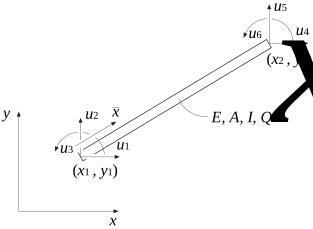
beam2geprovides the global element stiffness matrix \({\mathbf{K}}^e\) for a two dimensional beam element with geometric nonlinearity considering approximate solution.The input variables:
ex\(= [x_1 \;\; x_2]\) \(\qquad\)ey\(= [y_1 \;\; y_2]\) \(\qquad\)ep\(= [E \; A\; I]\)supply the element nodal coordinates \(x_1\), \(y_1\), \(x_2\), and \(y_2\), the modulus of elasticity \(E\), the cross-section area \(A\), and the moment of inertia \(I\).
The input variable
Qx\(= [Q_{\bar{x}}]\)contains the value of the predefined axial force \(Q_{\bar{x}}\), which is positive in tension.
The element load vector \({\mathbf{f}}_l^e\) can also be computed if a uniformly distributed transverse load is applied to the element. The optional input
eq\(= [q_{\bar{y}}]\)contains the distributed transverse load per unit length, \(q_{\bar{y}}\). Note that
eqis a scalar and not a vector as inbeam2e.- Theory:
The element stiffness matrix \(\mathbf{K}^e\), stored in the variable
Ke, is computed according to\[\mathbf{K}^e = \mathbf{G}^T \bar{\mathbf{K}}^e \mathbf{G}\]where \(\bar{\mathbf{K}}^e\) is given by
\[\bar{\mathbf{K}}^e = \bar{\mathbf{K}}^e_0 + \bar{\mathbf{K}}^e_{\sigma}\]with
\[\begin{split}\bar{\mathbf{K}}^e_0 = \begin{bmatrix} \frac{D_{EA}}{L} & 0 & 0 & -\frac{D_{EA}}{L} & 0 & 0 \\ 0 & \frac{12 D_{EI}}{L^3} & \frac{6 D_{EI}}{L^2} & 0 & -\frac{12 D_{EI}}{L^3} & \frac{6 D_{EI}}{L^2} \\ 0 & \frac{6 D_{EI}}{L^2} & \frac{4 D_{EI}}{L} & 0 & -\frac{6 D_{EI}}{L^2} & \frac{2 D_{EI}}{L} \\ -\frac{D_{EA}}{L} & 0 & 0 & \frac{D_{EA}}{L} & 0 & 0 \\ 0 & -\frac{12 D_{EI}}{L^3} & -\frac{6 D_{EI}}{L^2} & 0 & \frac{12 D_{EI}}{L^3} & -\frac{6 D_{EI}}{L^2} \\ 0 & \frac{6 D_{EI}}{L^2} & \frac{2 D_{EI}}{L} & 0 & -\frac{6 D_{EI}}{L^2} & \frac{4 D_{EI}}{L} \end{bmatrix}\end{split}\]\[\begin{split}\bar{\mathbf{K}}^e_{\sigma} = Q_{\bar{x}} \begin{bmatrix} 0 & 0 & 0 & 0 & 0 & 0 \\ 0 & \frac{6}{5L} & \frac{1}{10} & 0 & -\frac{6}{5L} & \frac{1}{10} \\ 0 & \frac{1}{10} & \frac{2L}{15} & 0 & -\frac{1}{10} & -\frac{L}{30} \\ 0 & 0 & 0 & 0 & 0 & 0 \\ 0 & -\frac{6}{5L} & -\frac{1}{10} & 0 & \frac{6}{5L} & -\frac{1}{10} \\ 0 & \frac{1}{10} & -\frac{L}{30} & 0 & -\frac{1}{10} & \frac{2L}{15} \end{bmatrix}\end{split}\]\[\begin{split}\mathbf{G} = \begin{bmatrix} n_{x\bar{x}} & n_{y\bar{x}} & 0 & 0 & 0 & 0 \\ n_{x\bar{y}} & n_{y\bar{y}} & 0 & 0 & 0 & 0 \\ 0 & 0 & 1 & 0 & 0 & 0 \\ 0 & 0 & 0 & n_{x\bar{x}} & n_{y\bar{x}} & 0 \\ 0 & 0 & 0 & n_{x\bar{y}} & n_{y\bar{y}} & 0 \\ 0 & 0 & 0 & 0 & 0 & 1 \end{bmatrix}\end{split}\]where the axial stiffness \(D_{EA}\), the bending stiffness \(D_{EI}\) and the length \(L\) are given by
\[D_{EA} = EA;\quad D_{EI} = EI;\quad L = \sqrt{(x_2 - x_1)^2 + (y_2 - y_1)^2}\]The transformation matrix \(\mathbf{G}\) contains the direction cosines
\[n_{x\bar{x}} = n_{y\bar{y}} = \frac{x_2 - x_1}{L} \qquad n_{y\bar{x}} = -n_{x\bar{y}} = \frac{y_2 - y_1}{L}\]The element loads \(\mathbf{f}^e_l\) stored in
feare computed according to\[\mathbf{f}^e_l = \mathbf{G}^T \bar{\mathbf{f}}^e_l\]where
\[\begin{split}\bar{\mathbf{f}}^e_l = q_{\bar{y}} \begin{bmatrix} 0 \\ \frac{L}{2} \\ \frac{L^2}{12} \\ 0 \\ \frac{L}{2} \\ -\frac{L^2}{12} \end{bmatrix}\end{split}\]